Depression after Ayahuasca: becoming aware of the suppressed problems of your life
Ayahuasca can bring unresolved conflicts and topics from your subconscious into your awareness. And these topics are not sitting somewhere separate from your life. They already affect how you feel, which relationships you choose, and which direction you take. In a way, sensing that something is still unresolved is often what draws you toward ayahuasca in the first place.
You may return home with this one blunt thought: "Ayahuasca made me depressed." I understand. But healing rarely happens with a snap of a finger, because seeing the conflict is only the beginning. Then comes the homework. You are confronted with what needs your attention, and after that, changing something in your life is your responsibility. So again, the difficulty can also be as much a part of the process as the ceremony itself, even if you would prefer everything to move faster.
Maybe you used to cruise through life, living one day after the other. Without major problems or major success. A normal life. And after you drank Ayahuasca, you start to see all the things which are wrong in your life. And you start to feel depressed after Ayahuasca.
It’s like Ayahuasca shows you your life without the filters, with details you never noticed before. You start to see the recurring themes and patterns in your life.
Love and Heartbreak
Take your romantic relationships, for example. After drinking Ayahuasca, it’s like you suddenly see patterns you were blind to before. Why do I always fall for the same kind of person? Or the painful realization that you also played your part in some of your love stories.
Your relationship with work
Then there is your work. Ayahuasca might lead you to ask, ‘Am I really passionate about what I do, or am I just chasing that paycheck? Am I in the profession that I am in to make my parents proud or did I actually choose it for myself?’ It’s like suddenly having clarity about your professional trajectory, realizing how much it’s tangled up with your self-worth, ambitions, or maybe even fears.
Your friendships
Then there are your friendships. Ayahuasca can make you question these bonds too. Are these friendships real and nurturing, or just convenient alliances? Do your friends reflect who you truly are, or who you pretend to be?
Your Social Patterns
And then there is the way you interact with others. You might start to see that the social dance you do, whether it’s being the life of the party or the wallflower, is often just a reaction to past traumas or insecurities. It can be confronting to realize that a lot of your patterns are actually trauma responses, isolating yourself so you won’t be rejected or getting hurt.
Maybe you are always socializing because you cannot be with yourself. That you use other people to your own self-benefit or that other people use you. This can have a serious impact on your mental health.
Must read blog: Ayahuasca Integration Guide
You awaken to the hard truth to the way you have been living your life
With all these patterns exposed, post Ayahuasca depression might start to kick in and you start questioning the life you’ve been leading. It can be a bit unsettling, like you’ve been living a lie or like you’ve wasted a lot of precious time. It can feel like a spiritual hangover, making you wonder if that Ayahuasca retreat was worth it after all.
Remember, Ayahuasca is like a magnifying glass to your soul, so it’s bound to reveal some uncomfortable truths. Acknowledging them is the first step to transforming them.
My Own Lows After Ayahuasca
Yes, I have been through many lows after ayahuasca myself. I remember one period after a retreat when I was extremely emotional and could not work on my computer or function normally. Everything was overwhelming, and also the simple tasks felt difficult.
Another time, the retreat had gone well, but after everybody left I felt lonely and isolated. By then, I had more experience with ayahuasca, and I knew I did not need to overanalyze every emotion. I understood that it was simply sadness from my subconscious starting to release.
Before ayahuasca, I had some direction in my life. Once I started drinking ayahuasca, I began changing my personality, becoming more myself, and adjusting the path I was taking. That readjustment period was confusing, difficult, and overwhelming, but for me it was necessary.
I think life is a teacher, and everything that comes up can teach you something when you are ready to receive the lesson. During the last few years, I have not experienced those lows in the same way. I still make adjustments, obviously, but now the path I am taking is clear.
How Common Is Depression After Ayahuasca?
The 2022 Global Ayahuasca Survey found that 55.9% of 10,836 participants experienced difficult mental-health effects in the weeks or months afterwards. That covers more than depression, but it shows how common a hard period is.
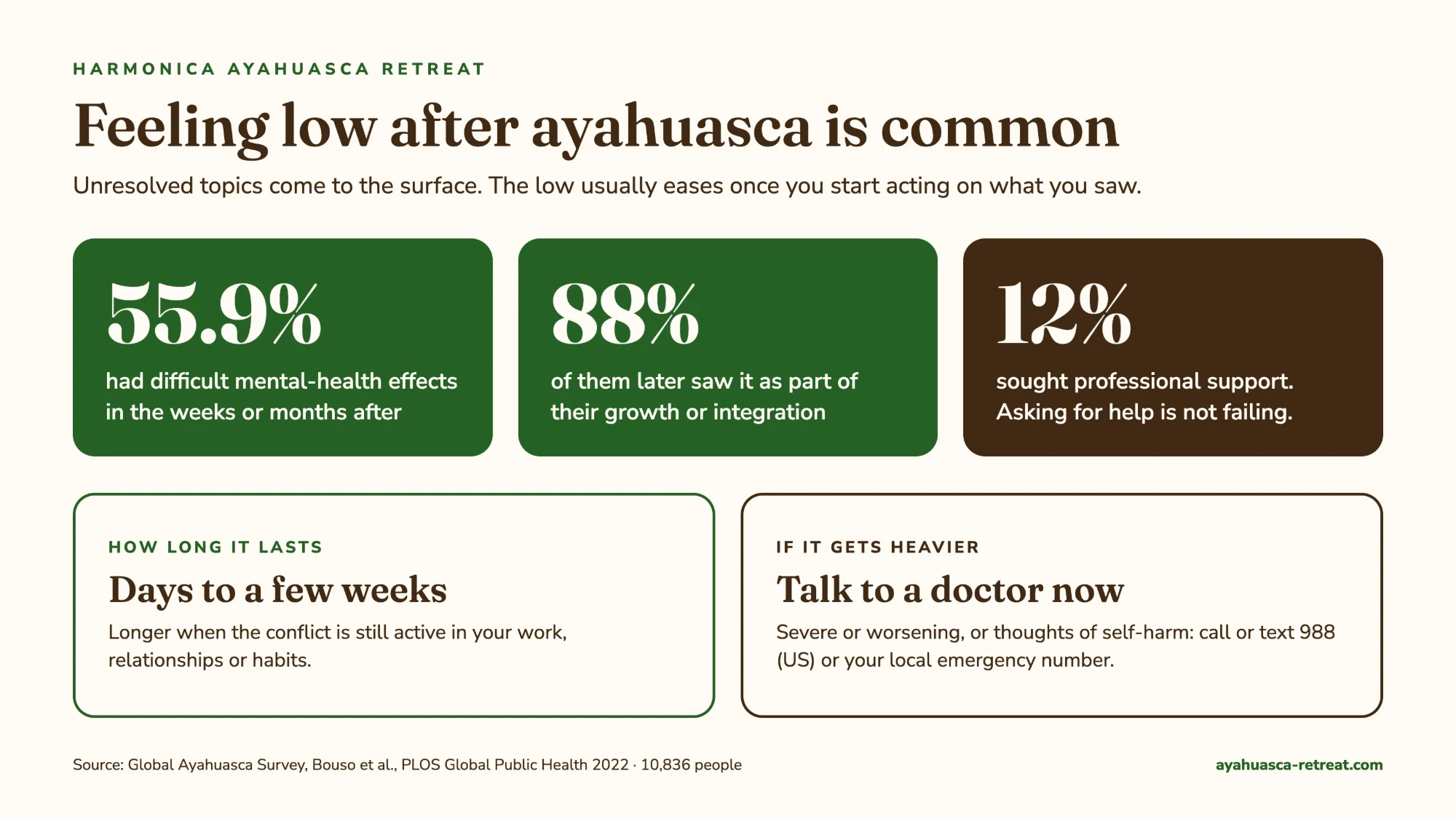
Around 88% of the people who experienced these effects later understood them as part of a positive process of growth or integration. Around 12% sought professional support for what they were experiencing. Asking for support does not mean the process failed.
Difficult mental-health effects were more likely among people with anxiety disorders and also among people who reported a stronger spiritual experience. They were less likely among people who drank ayahuasca in religious settings.
The survey included people who chose to answer an online questionnaire, so the results may not represent everybody who drinks ayahuasca. And also, if you are struggling, you are not the only one, and you do not have to carry it alone.
How Long Does Depression After Ayahuasca Last?
Most lows after ayahuasca last days to a few weeks, and from what I see, they usually ease once you are ready to learn the lesson and begin making the needed changes. There is no fixed timeline, and obviously, each person and each situation is unique.
Some ayahuasca after effects pass when your sleep and usual rhythm settle again. And also, post ayahuasca depression may stay longer when the ceremony brought up a conflict that is still active in your work, relationships, habits, or home environment.
I would try to look less at fighting the low and more at what it is asking you to face. Also look at whether you are taking responsibility for the changes you already know you need to make. If it is getting heavier instead of lighter, read the warning signs below.
Wrestling with Your Inner Demons: Sadness vs. Depression
Before we venture further, let’s clear up one crucial thing, feeling sad, being alone, or feeling isolated isn’t the same as being depressed or having a major depressive disorder. It’s like comparing an afternoon rainfall to a full-blown thunderstorm. Now, I’m not minimizing these emotions, they’re pretty heavy, trust me, I know. But it’s essential to understand that they don’t always mean you’re in the grip of depression after Ayahuasca.
You see, when you take Ayahuasca, it’s like you’ve just uncorked a fizzing bottle of your subconscious. It’s like disturbing a stagnant pond, there’s a lot of old, murky water (or emotions, in this case) that has been sitting unnoticed, and now it’s all stirred up. But that’s part of the process and can be one of the effects of Ayahuasca.
When you’re feeling all these intense emotions, it might be tempting to reach for your usual coping mechanisms, maybe it’s a tub of ice cream, a Netflix binge, or even burying yourself in work. But what if you just sat with the feeling instead? Let it wash over you like a wave. It might be uncomfortable, even painful, but remember, this feeling is part of the healing process.
However, if what you’re feeling is more profound, if it feels like you’re sinking into the quicksand of depression, then we need to talk. This isn’t about just feeling down; it’s about feeling so low that you struggle to find the will to rise.
Warning Signs That It Is More Than Sadness
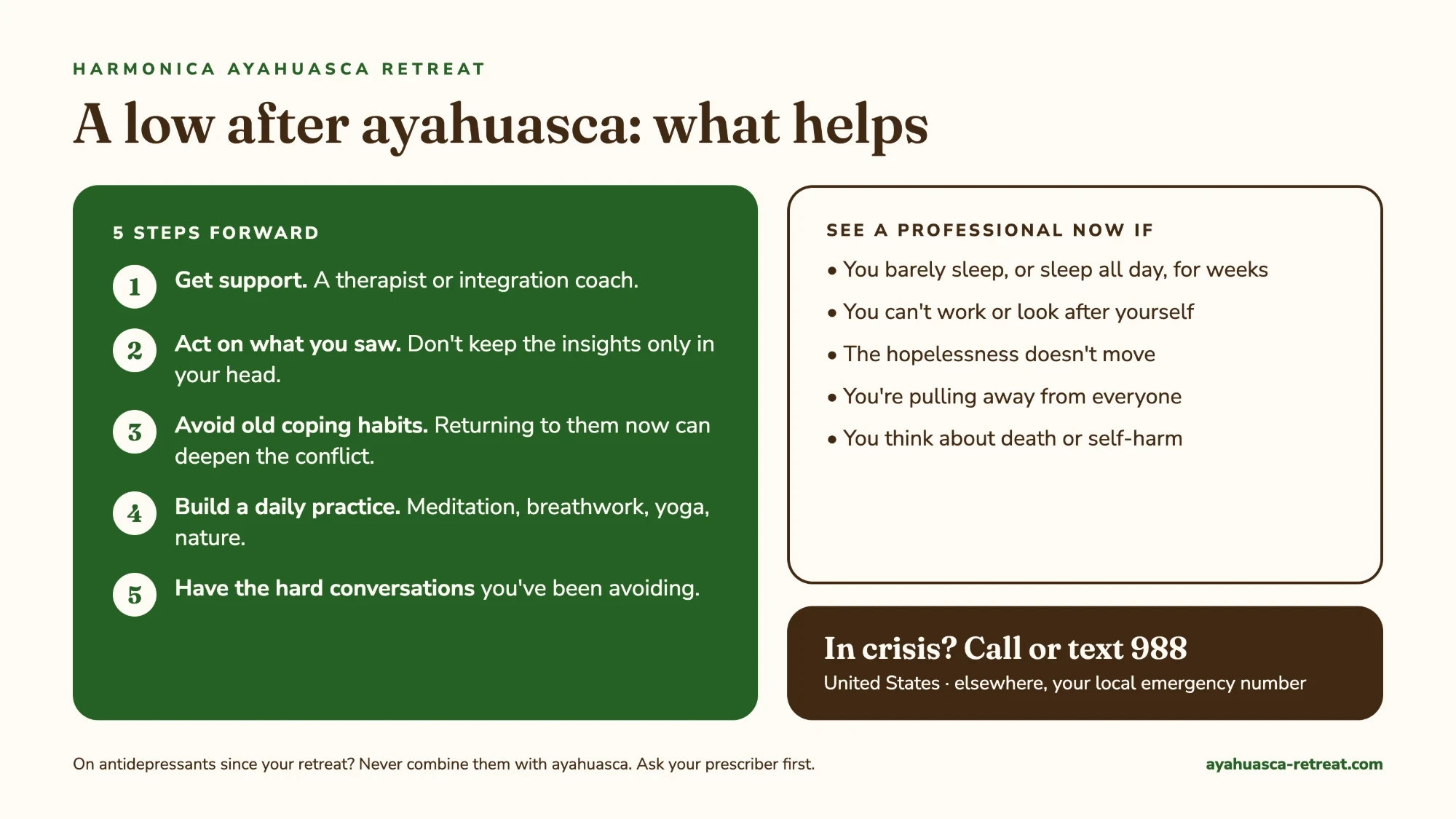
A low needs professional attention quickly when you cannot function or when keeping yourself safe becomes difficult. Watch for signs such as:
- You are barely sleeping or sleeping all day for weeks.
- You cannot work or look after yourself.
- The hopelessness does not move.
- You are pulling away from everyone around you.
- You are thinking about death or harming yourself.
These are reasons to see a doctor or therapist now, not to wait and hope it passes. If you are thinking about harming yourself, call or text 988 in the United States or contact your local emergency number today.
I would also look at how you were doing before the retreat and what your own inner intelligence is saying now. Why do you think you are depressed? What does your support system look like, and which practices help you through difficult periods?
A guest came to our retreat after living with crippling depression for many years, and ayahuasca helped him a lot. His way of looking at it stayed with me: there is a reason you have a depression. What are you not facing? What are the unresolved issues in your life? These questions do not replace professional care.
Depression after Ayahuasca: Focus on the positive
When you’re on this unanticipated emotional rollercoaster after your Ayahuasca journey, it’s easy to lose faith and confidence. You might even wonder if you’ve done something terribly wrong.
Realizing you’ve got stuff to work through is a good thing. It might not feel like it now, but trust me, it’s better to uncover these emotional landmines now than stumble upon them in 5, 10, or even 20 years. Awareness isn’t just the first step towards change, it’s a giant leap.
Pain, as much as we despise it, is often the catalyst for change. When was the last time you decided to change something when everything was comfy and cozy? But when things get rough and the pain becomes unbearable, that’s when we say enough is enough. It’s like a wake-up call that urges us to grow and evolve.
Why Going Back to Old Habits Makes the Low Worse
Going back to old coping habits after ayahuasca can make the low worse, because now you see the conflict that this habit was covering. Somebody may have used weed to numb emotional overwhelm, because it felt like the only way to get through the day. After ayahuasca, the person may see much more clearly how this pattern is affecting their life.
“Ayahuasca confronts us with our unresolved issues. It’s an invitation to heal, but if you start ignoring them and go back to your life like nothing happened, your inner self will create more suffering so you are “forced” to change.”
 Oliver GlozikFounder of Harmonica Retreat
Going back to weed then feels different. Afterwards, the choice feels conscious, and with that awareness there can also come a much bigger inner conflict.
A friend of mine likes to say, "Don't eat your ayahuasca vomit." It is meant figuratively. When you have purged a pattern, or you have seen clearly that it is hurting you, returning to it can create even more turmoil than before.
I saw this with another friend who used painkillers to get through his day and sometimes overused them. After ayahuasca, he reached for a painkiller during a low moment. Instead of helping him through that moment, it made him feel much worse than it had before.
The same inner conflict can happen with toxic habits, relationships, or environments. In a way, once your spirit knows that something is damaging you, re-engaging with it can deepen the struggle inside you. It is less about forcing everything at once and more about no longer pretending you did not see what you saw.
So, what’s next? Post-Ayahuasca Depression
Here are a few things that might help you get back on your feet.
Seek Professional Help
Speaking with a therapist or an Ayahuasca Integration Coach could be incredibly beneficial. These professionals understand the nuances of post-Ayahuasca depression and can offer practical advice and coping strategies.
Support Harmonica Offers After a Retreat
When a past guest reaches out in an emergency, we are always available for a call, free of charge. And also, we hold free monthly integration calls for our community.
Past participants can also use our free online ayahuasca integration course. Through the calls and integration resources, we support people as well as we can. But at a certain point, each person also needs to take responsibility for where they are and start making the changes their life is asking for.
Consider Another Ayahuasca Retreat
This might sound counterintuitive while you are wrestling with depression after Ayahuasca, but hear me out.
Drinking Ayahuasca again could provide you with the clarity you need. It could help you untangle the knots that have formed in your emotional fabric.
We recommend checking out our Ayahuasca Retreat Center in Colombia if that resonates with you.
Another retreat may make sense depending on where you are, how you were doing before the first retreat, and whether you feel ready to return. If you have started an antidepressant since then, speak with your prescriber before drinking again because antidepressants and ayahuasca must not be combined. And if any of the warning signs above apply to you, see a professional before planning another retreat.
Develop a Spiritual Practice
Cultivating a regular spiritual practice can work wonders for your mental well-being. This could involve meditation, breathwork, yoga, or even working out, whatever resonates with you. It could also include activities like gardening or playing music, essentially anything that helps you connect with your inner self and nature.
Try Other Healing Modalities
Different healing modalities can give you another way to work with what came up. Somatic practices may help you stay with the sensations and emotions you notice in your body, instead of running away from them. A facilitated Conscious Connected Breathwork session can also become part of your preparation or integration practice.
And also, hypnosis may suit some people. It can be that one practice fits your temperament. It can also be that your situation asks for something different, so you may need to try several practices before finding what works for you. Developing a spiritual practice is less about copying what worked for somebody else and more about finding something you can return to with patience and seriousness.
Have Those Difficult Conversations
It’s time to have those conversations you’ve been avoiding, be it with your partner, a friend, a family member, or even yourself. These could be about your feelings, your needs, things that happened in the past or the changes you want to make in your life.
Yes, these conversations will be hard, and yes, they might lead to uncomfortable revelations. But remember, honesty, even when painful, is the first step towards healing.
You will come out of it a better person.
Over the years, I’ve encountered many individuals whose lives seemed to spiral into chaos after an Ayahuasca retreat. Their world turned upside down, their emotions became wild, and their once stable existence became a rocky road that they could hardly recognize. They shared how they wouldn’t wish that experience on their worst enemy.
Despite the turmoil, the confusion, and the despair, the people I am thinking of agreed on one thing: that challenging phase was exactly what they needed at that point in their lives. Once they came through it, they were grateful for the experience, saw it as the catalyst for change, and are much happier where they are now.
Ayahuasca will only give you what you can handle.
A friend of mine has been drinking Ayahuasca for over 5 years now. In year 4 of his Ayahuasca journey, memories of sexual abuse in his childhood started to surface that he didn’t remember. It is definitely something difficult to handle. However, it only came up in year 4 after many, many ceremonies.
Ayahuasca is a master plant; in a way, it knows you better than yourself. Ayahuasca will not give you more than you can handle. Maybe it seems like a lot to you right now, but remember in your soul that you are also a lot stronger than you think you are. There is a reason the things that came up to you came up. And remember that you have the strength and emotional capacity to handle it, and you will come out better on the other end.
From what I have seen, I believe ayahuasca gives you what you can handle, but that belief is never a reason to carry something alone when it feels too heavy. Strength also means reaching out and accepting support.
The low can be part of the healing journey, and as you take responsibility and act on what you saw, it can begin to ease. If you want support with that, book a free 30-minute call.