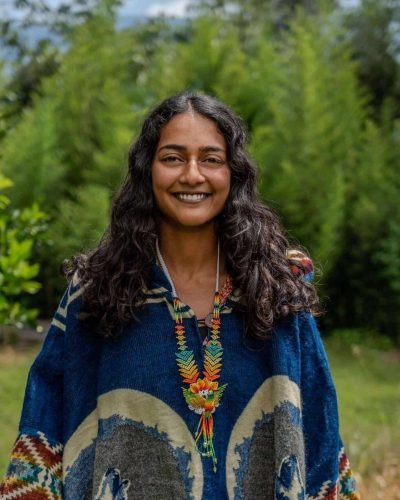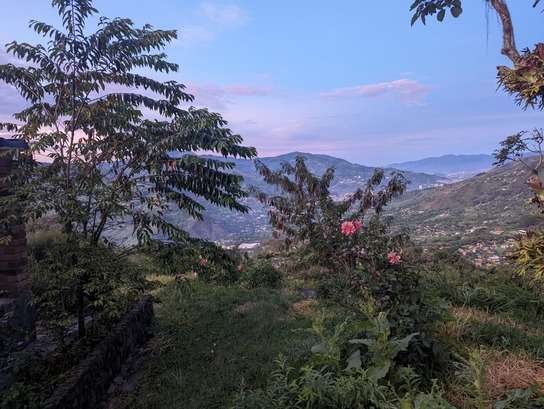
I never pictured I’d be volunteering at an Ayahuasca retreat centre in Colombia, but this is what I’ve been up to for the past couple of months, and I’m actually really loving it. Quite a radical new trajectory from being a software engineer in Old Street, London. You might be wondering, how did this come about, and what is it like?
I initially came to Colombia to work remotely from Medellin for 2.5 months whilst working as a software engineer for a company in London (in a job and company that I loved). During a two week holiday in February, I attended an Ayahuasca retreat in the surrounding mountains 1 hour from the city.
I want to explain a bit about my motivations for going in the first place, I think the general preconception of Ayahuasca in the West can be quite negative/fear-mongering (think I’ll do a separate post to expand on this).
Understanding Ayahuasca: A medicine from the Amazon
Ayahuasca is an indigenous plant medicine grown and cooked in the Amazon jungle that has been used for thousands of years by the communities there. It’s considered a medicine for the spirit, and only recently in the last 20 years has started to come to the cities. It expands your state of consciousness and allows you to look within yourself, revealing many truths about life, your purpose, past traumas that still affect you today etc, and puts you on a path of healing allowing you to grow past things that are keeping you stuck.
Let me be clear, a person doesn’t drink Ayahuasca for psychedelic effects but instead because they really want to search within for certain understandings. It’s intentional rather than recreational.
Must read blog: What is Ayahuasca?
My personal experience at the Guacamayo Retreat Centre
I decided on the Guacamayo retreat centre just outside Medellín because it aligned with my work and travel plans. While doing research I saw that this place had hundreds of excellent reviews, with many people highlighting how safe, comfortable, and guided their experiences were here, important factors for me given the stories I’d heard about less responsible retreats.
My experience was so beautiful; I came with longstanding questions about my anxiety and depression which I’ve had since being a teenager, and the insights, acceptance and healing I gained during and after the retreat were life-changing. For example, one consequence was choosing to stop taking antidepressants in order to learn how to regulate my own emotions, and I’m now getting closer to a place where I am doing this, which is kind of major for me.
Must read blog: Ayahuasca Intention
Looking to attend a Ceremony? Book a free 30-minute phone call.
Receiving some bad news…
During my retreat, whilst I was having profound personal discoveries, I received the unexpected news that I was going to lose my job back home and was going to take redundancy. After I found out I spoke with Oliver, the organiser of the retreat. I shared how thanks to my recent experiences in the ceremonies, I felt surprisingly fine about the situation. Under different circumstances I’m sure I’d have been incredibly stressed, but I was calm, and mostly viewed it as an exciting opportunity to extend my stay in Colombia (and potentially volunteer in hostels).
A few days after leaving the retreat, Oliver and I continued our conversation, and he offered me the opportunity to be a volunteer at the retreat centre for a couple of months. I was so happy to accept, for so many reasons!
Accepting the offer to be an Ayahuasca retreat volunteer
Firstly I already had a connection with the place and knew it was a good energy match with Oliver having spent a week here as a participant. I was inspired by the work I observed the team do during my retreat, in the ceremonies in particular, as well as by the positive changes I saw in others and myself. This made me to want to help wherever it was needed in this work, with this particular community.
I was excited by the prospect of meeting a variety of participants and to develop relationships with the team who I already thought were really cool and did amazing jobs. It was a great opportunity to focus on my own inner work, which is a priority for me at this time. Finally an additional perk was that I’d have the chance to develop my Spanish skills.
Life as an Ayahuasca Retreat Volunteer
“Through this work I’ve connected deeply with the nature of Colombia, and even developed what feels like individual connections with each plant, strange as that may sound.”
Initially, my role evolved from “enjoying myself” to doing a lot of manual labour i.e. cleaning, cooking and gardening, which kept me physically active and gave me an understanding of the daily rhythms of the finca. Since then it has evolved further, outside of retreats this looks like a mix of gardening and online tasks, such as researching, writing and uploading blogs to our website. I enjoy these both and fortunately do much less cleaning now.
Gardening
The garden is a significant part of my life here, and deserves its own section. The site (finca) we live on is incredibly large with a diverse array of plants, including lime trees, banana trees, a mandarin tree, aloe vera, day lilies, dahlias, bird-of-paradise flowers, as well as various medicinal plants, herbs, and vegetables.
Now it is the wet season and the rain takes care of watering the plants. But during the drier times, they required watering twice a day, a task that can take up to 2-3 hours each session simply because of the size of the finca. Realistically, I didn’t manage to water them all each day (sorry Oliver) and unfortunately, some would suffer.
But I do want to say, watering for hours at a time brought me to such a state of zen; I would become completely immersed and present in the task, only really thinking about which plant would be watered next. Over time, this became almost instinctual so I didn’t need to think and was a form of decompression for me.
I do other plant-care tasks such as transplanting offshoots, treating leaves with soapy water, removing caterpillars and squashing the aphids that eat the leaves! I also select new plants to grow from seeds and am currently learning how to propagate plants around the finca. A goal is to create a vibrant corridor of plants either side of the pathway leading up to the house I live in. It’s kind of a creative endeavour as I get to choose what to grow and what plants will go where.
Our medical doctor Kevin often uses herbs from the garden, such as Cidron and Toronjil, to create teas or infused waters to help people manage their nerves or anxiety or dodgy stomachs, myself included. Through taking care of this garden I finally understand what the term symbiosis means in this context; we care for the plants and invest our energy into them, and they care for us, nourish and re-energise us in return. 🙏
I’m amazed I get to do this for work every day, as it brings me immense joy, presence, satisfaction and connection. It’s allowed me to tap into and develop a nurturing energy. I have felt this way before when growing tomatoes with my mum in her garden, more low-key and not as long-lived but a similar sensation.
Final thing I want to say about the matter, I’ve observed how when the plants are watered and healthy, the garden attracts many more birds, butterflies and other insects. I’ve seen so many new and cool species including the Racket-tailed Colibri and the Green Jay. Through this work I’ve connected deeply with the nature of Colombia, and even developed what feels like individual connections with each plant, strange as that may sound.
Participation and Work During Retreats
During retreats I both work and participate. Tasks include preparing the ceremony space, preparing the ice bath, helping with breakfast and lunch, cleaning buckets, doing laundry and washing dishes. I also find myself frequently stepping in to assist with various ad-hoc tasks, and I’ve noticed the same collaborative spirit among the team, and sometimes even participants.
Regarding retreat activities, I particularly enjoy doing the holotropic breathwork session followed by spending 10 minutes in the ice bath, and I love doing the yoga session led by Valentina.
I enjoy being part of the sharing circles after ceremonies, where I’ve been honing my active listening skills and gradually gaining confidence in sharing my own experiences. I’m hopeful that as my confidence grows, I’ll be able to respond more openly to others when they share.
A theme for me recently has been figuring out where my limits are and how to draw lines and stick to them to make sure I look after myself properly and don’t become exhausted (particularly during the 7-day long retreats). Participating and working at the same time can take it’s toll, but I definitely notice an improvement in how I’m prioritising rest and recuperation.
The ceremonies themselves are a privilege to be a part of, in particular I want to mention how amazing the music is during the ceremony, and to mention the hard work that goes into the facilitation and the level of attention to detail for each person in that room. It is actually a goal of mine to train to become a facilitator, once I’m ready.
Must read blog: Ayahuasca ceremony, what to expect?
Interpersonal Connections
Luckily I’ve found a mentor in Oliver; he actively supports the paths I choose to pursue, encouraging me to focus on work that I enjoy and will do well in. We have in-depth 1-1s, which are interesting and motivating, as he often pushes me to realise my potential when I might be overlooking it. Also I’m quite lucky that he is a friend, and someone with a good sense of humour, we have many laughs which I think is important in a job!
“These interactions enrich my life here, creating a strong sense of belonging for me.”
I’ve developed friendships with other team members who are supportive and also bring a lot of joy, humour and insight into everyday situations. They are incredibly kind, and so musically talented which brings a creative energy to the atmosphere at the finca, and I’m very glad to have met them. I’m actually learning how to sing here with them too 😁
Interacting and connecting with the participants during retreats is particularly rewarding for me, I love the energy they bring to the finca, I love seeing how everyone’s journey progresses, and how we, and they, all bond. I’ve met a lot of amazing people so far, and feel like if I visited some of the cities where they live I’d have friends I could meet up with.
The community here extends beyond just the immediate team, I’ve connected with many other people, including Sam who also lives here and other people who visit the finca. In addition I’ve met other Colombian people in this community as I have been to a public Colombian ceremony with 40+ Colombians, and a private Colombian ceremony too. Despite not knowing much Spanish, they are very patient and keen to communicate! These interactions enrich my life here, creating a strong sense of belonging for me.
Wrapping up…
In the end, my redundancy led me to what might seem like an unexpected place to work. But I find it hard to articulate how much I enjoy being here. Every day I contribute to work that feels so meaningful, I get to immerse myself in my personal development, and connect to the power of nature.
This opportunity will extend my stay in Colombia by 3.5 months, and likely even more, as my role continues to develop and I take on greater responsibilities at the retreat centre. I’m not sure about what’s to come in the coming months, especially with respect to my professional trajectory, but I’m embracing the day-to-day and living each moment much lighter and happier than before.
Muchas gracias 🙏🌌
How Ayahuasca Retreat Work-Exchange Actually Works
Work-exchange at an ayahuasca retreat means you trade daily help for a place to stay, meals, and sometimes a spot in ceremony, instead of paying the usual retreat fee. It is not a paid job. It is closer to living inside the community than clocking a shift for wages.
The exact deal changes from one centre to the next, so it helps to ask early. It can be that a centre gives you lodging and food in return for a set number of hours. It can also be that they include access to a ceremony or two once you have settled in and they trust how you hold the space. It can also be that the arrangement is looser, and you simply become part of the daily rhythm of the finca the way I did.
For me the work started as a lot of manual labour and slowly grew into gardening plus online tasks like researching and writing these blogs. Most volunteer roles look like this: practical, hands-on, and less about the medicine itself than about keeping the place running so the ceremony work can happen. If you are picturing a retreat that normally costs a fair amount of money, work-exchange is how some people stay for months rather than days without that fee. It helps to know roughly what an ayahuasca retreat costs so you understand what your time is worth in the exchange.
One thing I want to be clear about. Whether you get to drink at all depends on the centre and on what you are responsible for during retreats. When the guests are in ceremony, someone needs to stay grounded and hold the practical side, and that someone is often the volunteer. So do not arrive expecting to sit in every ceremony. Come expecting to serve, and let the ceremonies you do get feel like a gift rather than the reason you came.
What to Check before You Volunteer at an Ayahuasca Retreat
Before you volunteer at any ayahuasca retreat, check that the centre screens its guests, works with an experienced facilitator, and is clear about what you give and what you get back. A place that stays vague about all three is a place to walk away from.
A few things are worth watching for. The first one is a centre that treats volunteers as free labour and offers nothing real in return, with no proper lodging, no learning, and no care for how you are doing. Another one is a facilitator who was somehow certified in a few weeks, or who leans on a spiritual ego instead of years of training under a teacher. If the person guiding the work makes you uneasy, that feeling is worth listening to. I would read up on what a real ayahuasca shaman actually is, and I would run any centre through a proper safe-retreat checklist before committing my time.
There is also the practical, less glamorous side that still matters. Check the visa rules for how long you can stay in the country, because a work-exchange does not usually change your status as a visitor. If you plan to actually drink during your stay, the same medical cautions apply to you as to any guest. Certain antidepressants, heart conditions, and a history of psychosis or bipolar disorder can make ayahuasca genuinely unsafe, so that is a conversation for a doctor and a screened facilitator, not something to sort out on arrival.
This path is not for everybody, and that is fine. If you are in real crisis and hoping that moving to a finca will fix things, I would gently say that is a lot to place on a garden and a few ceremonies. It can be that you need stable ground and support at home first, and volunteering later. Work-exchange suits you more when your life is basically intact and you want to go deeper, contribute, and give the inner work time. Less about running from something. More about showing up for something.
FAQs
How do you become an ayahuasca retreat volunteer?
You usually become an ayahuasca retreat volunteer by contacting a center directly and offering to help with tasks such as gardening, cooking, and supporting guests, often in exchange for lodging and ceremony access. Roles and requirements vary by center, so ask about expectations before committing.
Do ayahuasca retreat volunteers take part in ceremonies?
Volunteers often take part in ceremonies at some centers, though their main role is practical support such as preparing the space and assisting participants. Whether you can drink the medicine depends on each center's policy and your responsibilities during retreats.
What kind of people take ayahuasca?
People who seek ayahuasca come from many backgrounds and are often drawn by a wish to heal trauma, ease depression or anxiety, or find spiritual clarity. Motivations range from personal growth to recovery from difficult life events.
Do you get paid to volunteer at an ayahuasca retreat?
No, you are not usually paid to volunteer at an ayahuasca retreat. Instead of a wage you receive lodging, meals, and sometimes access to ceremony in exchange for your help, which is why it is called work-exchange rather than a job. Confirm the exact terms with the centre before you commit.
Can volunteering lead to working as an ayahuasca facilitator?
Volunteering can be a first step toward facilitation, but it is not a shortcut. Guiding ceremonies safely takes years of practice under an experienced teacher and real screening, so treat any centre that offers to certify you quickly as a warning sign rather than an opportunity.


![29 Best Ayahuasca Documentaries: Free & Paid [2026 Guide]](https://www.ayahuasca-retreat.com/wp-content/uploads/2026/02/ayahuasca-documentary-768x512.png)