Rapé — also written as rapeh, hapé, hapey, or rapéh — is a sacred plant medicine used by indigenous tribes of the Amazon for thousands of years. It comes as a fine powder, traditionally made from a blend of tobacco and medicinal plants, and is administered through the nostrils using a special pipe.
If you’ve recently heard about rapé in a spiritual or ceremonial context, or you’re preparing for an ayahuasca retreat and wondering what role it plays, this guide covers everything you need to know — from what it’s made of and how it’s applied, to what it actually feels like and how it works alongside ayahuasca.
What is rapé made of and where does it come from?
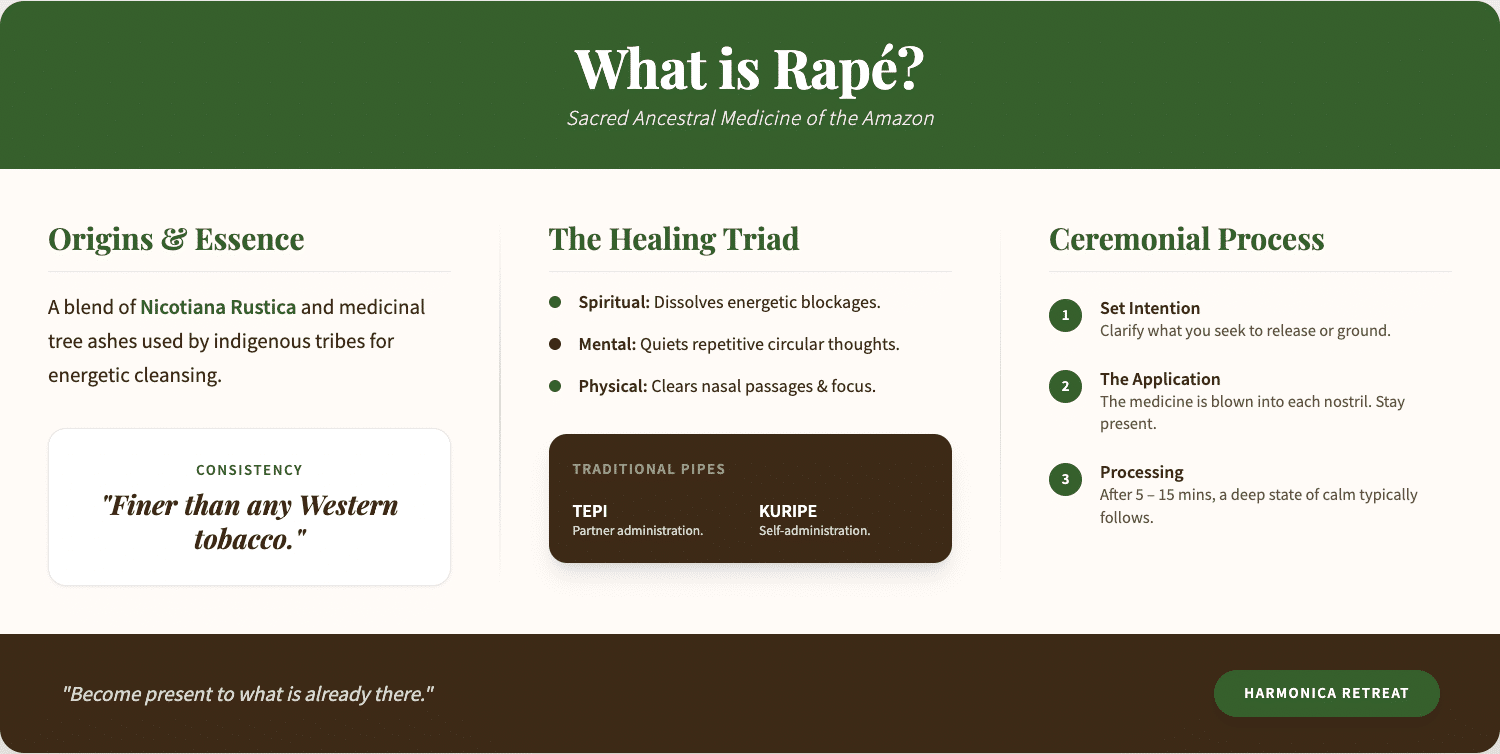
Rapé originates from the Amazon basin, with the greatest variety of blends coming from Brazil. It has been used for centuries by tribes including the Kaxinawá, Yawanawá, Katukina, Nukini, and Kuntanawa — each with their own traditional recipes, rituals, and intentions around its use.
At its core, rapé is made from Nicotiana rustica — a potent variety of tobacco significantly stronger than the commercially grown Nicotiana tabacum most Westerners are familiar with. This is combined with the ash of sacred or medicinal trees, and depending on the blend, aromatic plants, roots, seeds, and other botanicals. The exact composition of many traditional blends remains a closely guarded secret of the tribe that produces them.
The result is an extremely fine, dry powder — typically greyish in colour — with a consistency far finer than anything you’d associate with tobacco in a Western context.
Rapé benefits — spiritual, mental and physical
Rapé works on several levels simultaneously, which is part of what makes it difficult to describe to someone who hasn’t experienced it. The benefits reported by practitioners and participants span the spiritual, mental, emotional, and physical.
Spiritual benefits
Energetic cleansing and alignment Rapé is widely used to cleanse and clear the energetic field. Shamans work with it to re-align with their energy channels, deepen their connection to the spiritual world, and remove what is described as stagnant or negative energy. For participants, it can create a profound sense of being present — of arriving fully in the body and in the moment.
Overcoming emotional and spiritual blockages Rapé is effective in breaking through emotional and spiritual blockages. Sometimes there are things we struggle to push through or let go of on our own. The plant medicine can assist in this process, helping us release and move past obstacles that have become lodged — whether through old patterns, unresolved grief, or accumulated tension.
Processing the past Rapé can bring up memories and feelings from the past, prompting emotional release and integration. This can be a powerful tool for healing, as it helps you confront and process experiences you may have been carrying without fully acknowledging them.
Mental and emotional benefits
Breaking free from repetitive thoughts One of the most consistently reported effects of rapé is the interruption of repetitive thought patterns. Have you ever felt trapped in endless loops of circular thinking — turning the same situation over and over without resolution? Rapé can break that cycle with striking efficiency.
Oliver, founder of Harmonica Retreat, describes his personal relationship with the medicine this way:
“I tend to use rapé only in very specific situations. The most common is when I notice I’m emotionally reactive about a situation or person — when I have repetitive thoughts that aren’t serving me or the relationship. I want to let go of the emotional charge and see things more clearly. Rapé consistently helps me do that. It interrupts the loop and brings me back to something more grounded.“
Enhancing meditation When you incorporate rapé into your meditation practice, you connect with the energy and spirit of that particular blend of plants. This connection can silence compulsive thoughts and help you tune in to your inner self, allowing messages of clarity and peace to come through. These messages can manifest in unexpected ways — for example, you might become aware of a physical sensation, like tension in the back or chest, that you had been unconsciously suppressing. Rapé doesn’t cause these sensations; it simply helps you become present to what’s already there.
Physical benefits
Relieving headaches Rapé can work wonders for headaches. While it might initially intensify the discomfort — as the medicine pushes through — this is part of its process. Most people find that pushing through that initial intensity brings genuine relief and clarity on the other side.
Clearing nasal congestion Rapé’s cleansing properties work directly on the nasal passages. If you struggle with congestion, a runny nose, or chronic sneezing, rapé can clear the passages and make breathing noticeably easier — a purely physical effect that happens alongside whatever is occurring on the energetic level.
Boosting energy and alertness Rapé provides a distinct energy lift — partly through its nicotinic content, which stimulates the release of epinephrine, acetylcholine, and dopamine, and partly through what practitioners describe as the removal of stagnant energy. The result is a sense of being more awake, alert, and focused that many people find lasts well beyond the acute phase of the experience.
How is rapé applied?
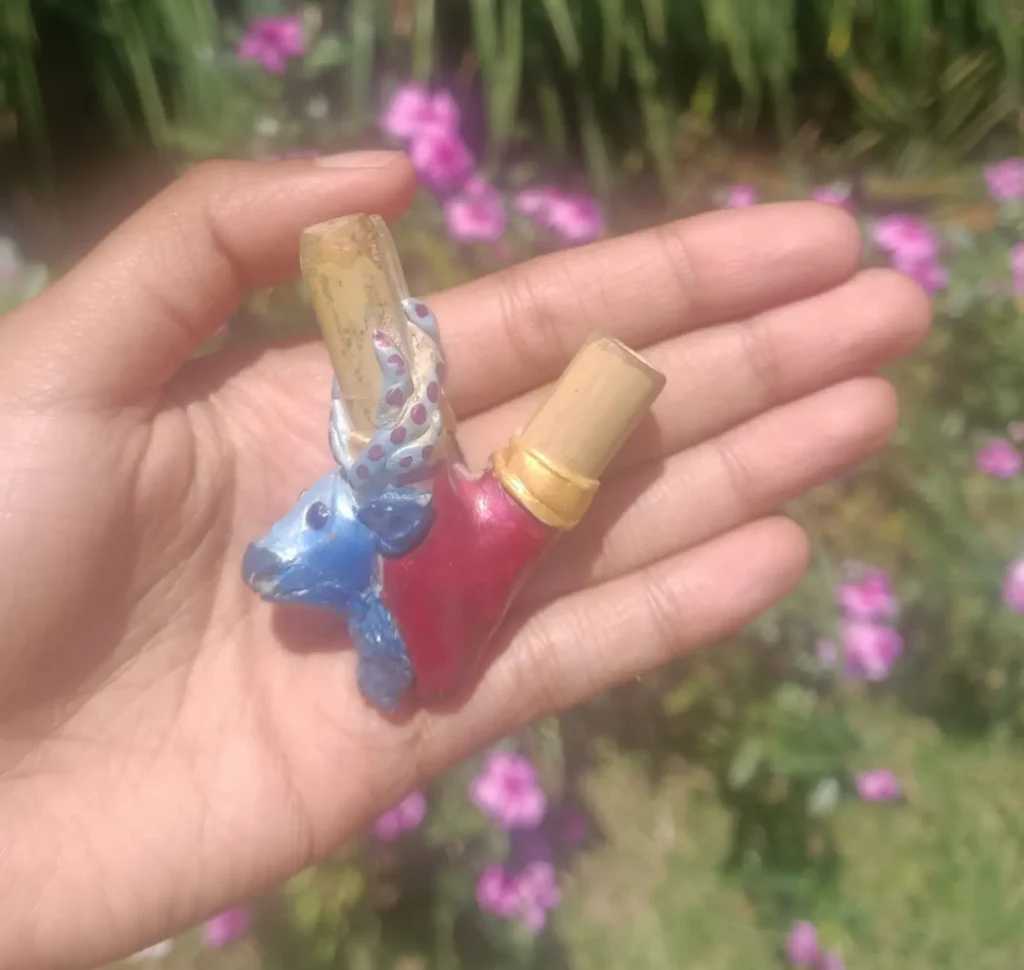
Rapé is not snorted, sniffed, or inhaled in the conventional sense. It is blown forcefully into the nostrils using a special pipe. There are two types of pipe used:
- Tepi — a longer pipe used when one person administers rapé to another. One end goes to the nostril of the recipient, the other end is blown by the practitioner.
- Kuripe — a shorter, V-shaped pipe used for self-administration, connecting your own mouth to your nostril.
The process, when done with care and intention, unfolds something like this:
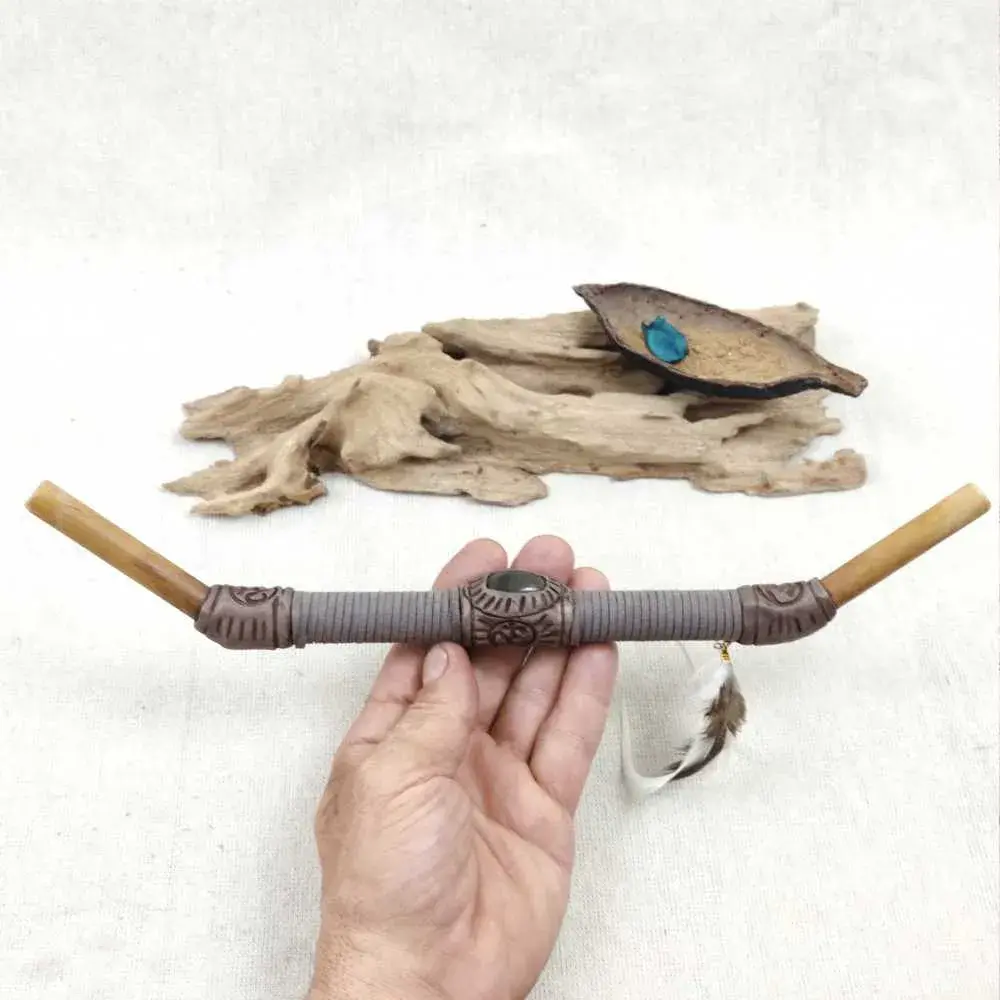
- Set your intention. Before anything else, take a moment to clarify what you’re bringing to the medicine. Whether that’s mental clarity, emotional release, grounding, or preparation for ceremony — the intention shapes the experience.
- Prepare your breath. Traditions vary slightly here: some suggest exhaling fully then holding, others recommend inhaling and holding. What matters is that you’re not breathing through your nose during application.
- Receive the blow. The rapé is blown into one nostril at a time with considerable force. This is not a gentle experience. The sensation is immediate and intense — a sharp pressure that moves from the nostrils through the forehead and into the head, followed by waves of sensation throughout the body.
- Stay with the experience. Physical reactions are common and considered part of the medicine: shivering, heat or cold waves, sweating, light-headedness, and in some cases nausea or vomiting. Apart from the physical experience, stay present with what comes up for you emotionally.
- Breathe only through the mouth. After application, keep your mouth open and breathe exclusively through it. After around five minutes, you can blow and clear your nose. The significant discharge that follows is considered the physical clearing of what the medicine has loosened.
The entire acute experience typically lasts between 5 and 15 minutes, though the grounded, clear quality it produces can persist for several hours.
How long does rapé last?
The acute phase — the intense physical and sensory experience immediately following application — generally lasts 5 to 15 minutes. During this window you may experience the full range of physical reactions described above.
What follows is typically a period of deep calm, clarity, and groundedness that many people describe as the real gift of the medicine. This quality can last anywhere from a few hours to the rest of the day, depending on the blend, the quantity used, and the individual’s sensitivity.
Unlike ayahuasca, rapé does not produce visionary states or extended psychedelic experiences. Its action is more immediate, more physical, and more grounding in nature.
The different types of rapé
Not all rapé is the same. Different blends carry different energies, intentions, and effects. At Harmonica Retreat, the selection of which rapé to work with in a given ceremony is made by the facilitator based on what the moment and the participant require. The blends we work with include:
Parika Known for its heart-opening properties. Parika is often used to help participants move through emotional blockages and connect more deeply with feelings of love, compassion, and vulnerability. In the context of ayahuasca ceremony, it can be particularly useful for someone who is struggling to open to the medicine.
Tsunu (Tsunú) Tsunu is one of the most popular types of rapé, known for its grounding and balancing effects. It is often used to help calm the mind, ease stress, and provide mental clarity. Tsunu is also beneficial for those seeking emotional stability and spiritual connection.
Nukini Nukini rapé is known for its gentle yet powerful healing properties. It is often used for clearing the mind, enhancing focus, and providing a sense of peace and tranquility. Nukini is suitable for meditation and for those seeking inner harmony.
Kuntanawa Kuntanawa is a strong and invigorating rapé, often used for energizing the body and mind. It helps to clear mental fog, increase alertness, and remove blockages that may hinder spiritual growth. This blend is ideal for ceremonies where heightened awareness and strength are needed.
Cacau Cacau rapé is made from cacao and is known for its heart-warming and nurturing effects. It is used to promote joy, emotional healing, and a deep sense of connection with oneself and others. Cacau is often applied during ceremonies that focus on self-love and community bonding.
Tobacco (Mapacho) A more traditional, tobacco-forward blend. Strong and grounding. Mapacho rapé is often used when a deep physical purge or energetic clearing is needed. It connects directly to the ancient shamanic relationship between tobacco and spiritual work in Amazonian culture.
Jiboia Jiboia means “boa constrictor” in Portuguese — and the energy of this rapé reflects that. It is known for its powerful, serpentine energy, and is used for deeper ceremonial work, particularly around shedding what no longer serves and moving through significant energetic or emotional constriction.
The selection of blend is not arbitrary. An experienced facilitator reads the energy of the ceremony and the individual, and chooses accordingly.
What happens in a rapé ceremony?
A rapé ceremony, in its traditional form, involves intention, prayer, and mutual administration. It is not simply the act of blowing powder into someone’s nose — it is a relationship between the practitioner, the medicine, and the recipient.
In a ceremonial setting, the facilitator will typically:
- Open the space with prayer or song
- Invite the participant to state or hold their intention
- Select the appropriate blend for the moment
- Administer the rapé to both nostrils, one at a time
- Hold space while the participant moves through the experience
- Close the process with gratitude
The role of the facilitator matters enormously. The energy, experience, and presence of the person administering the rapé directly shapes the quality of the experience.
Rapé and ayahuasca — how they work together
Rapé and ayahuasca have a long and intertwined history in Amazonian medicine traditions. Understanding how they relate to each other — and when rapé is used within an ayahuasca ceremony — is one of the questions we hear most often at the retreat.
Before the ceremony Rapé is frequently offered before the ayahuasca ceremony begins. It helps participants arrive — clearing mental noise, releasing surface-level tension, and bringing the body and mind into a more receptive state. It can also help clarify intention, cutting through distraction and settling you into a clearer sense of what you’re bringing to the ceremony.
It can also help clarify intention, cutting through distraction and settling you into a clearer sense of what you’re bringing to the ceremony — if you haven’t yet defined yours, our guide on setting an ayahuasca intention is a good place to start.
During the ceremony This is where the role of rapé becomes more nuanced, and where our Yagecero Sergio offers a perspective rooted in decades of ceremonial experience:
“In some cases, when people are having a hard time connecting to the ayahuasca, simply drinking more is not necessarily the answer. Usually there is a level of blockage — physical, emotional, or energetic — that doesn’t allow the medicine, or the person themselves, to go deeper. In those cases, it is highly recommended to apply a rapé. This strong physical process can allow for a deeper release — sometimes even activating the ayahuasca. After the application of rapé in an ayahuasca ceremony, when one drinks the next cup, the experience tends to unfold in a very different way.”
— Sergio, Yagecero, Harmonica Retreat
Can you use rapé outside of ceremony?
Yes — rapé can be used outside of a formal ceremonial context, and many practitioners incorporate it into their regular practice. That said, how and when you use it matters.
Common contexts for personal use include:
- Before or during meditation, to quiet compulsive thinking
- Before an important conversation or decision, to access greater clarity
- After an emotionally charged experience, to release and ground
- As a moment of connection with nature and with oneself
The important caveat: be mindful of your setting and the people around you. The act of receiving rapé can appear alarming to those unfamiliar with it. Use it in appropriate spaces.
How often should you use rapé? Most experienced practitioners suggest no more than 1–2 times per week for personal use. More frequent use can diminish the medicine’s effects and, in some cases, lead to a degree of dependency that undermines the self-awareness the medicine is meant to cultivate. Listen to your body. If you find yourself reaching for it automatically rather than intentionally, that’s a signal worth pausing on.
Can anyone apply rapé to others?
Technically, yes. In practice, we’d encourage real caution here.
Administering rapé well involves far more than loading a pipe and blowing. It requires reading the person in front of you — their energy, their process, what they need. It involves knowing which blend is appropriate, how forceful the blow should be, and how to hold the space for whatever emerges. An inexperienced application can produce a deeply unpleasant experience, and there are accounts of people feeling seriously unwell after receiving rapé from someone who lacked the depth of knowledge the practice requires.
If you encounter someone offering rapé at a festival or casual setting, that doesn’t mean the experience will be harmful — but it does mean asking: does this person truly understand what they’re working with?
hose exploring plant medicine often want to understand how different medicines compare before committing to a path. We’ve written detailed guides on ayahuasca vs bufo alvarius, ayahuasca vs peyote, ayahuasca vs san pedro, ayahuasca vs Iboga, and ayahuasca vs magic mushrooms — each covering the key differences in effects, duration, and what each experience is best suited for
Conclusion – the availability of this plant medicine around the world makes it a common choice in one’s plant medicine journey
Rapé — in all its spellings and all its forms — is one of the most immediate and grounding plant medicines available within the Amazonian tradition. Unlike ayahuasca, which asks you to surrender to a long inner journey, rapé is more readily available and still offer a powerful emotional reset and release.
Used with intention and administered by someone who truly understands it, rapé can be a profound tool — whether you encounter it in daily practice or as part of a ceremonial container alongside ayahuasca.
If you’re curious about experiencing rapé in a safe, guided setting, we offer it as part of our retreat program at Harmonica Retreat in Colombia.
Key takeaways
- Rapéh, also known as Hapey, is a traditional medicine used by indigenous tribes in the Amazon. It is a powder made from various trees and plants, applied through the nostrils using a special pipe.
- Like many of these plant medicines, it gets worse before it gets better. Immediate effects of the rapéh may be uncomfortable but in the longer term you can feel many benefits – mental, spiritual and physical.
- Rapéh is often used before an Ayahuasca ceremony as it can help participants calm their nerves and ground themselves. It also brings a level of clarity around their intention, setting a focused mindset.
Frequently asked questions around rapé, it’s benefits and application
What is rapé / rapeh / hapé / hapey?
They are all different spellings of the same medicine — a sacred Amazonian plant medicine made primarily from Nicotiana rustica tobacco and medicinal tree ash, blown into the nostrils in ceremony and personal practice.
Is rapé safe?
When used with intention and administered by an experienced practitioner, rapé has a long history of safe ceremonial use. The physical process is intense but purposeful. Certain conditions — such as recent nasal surgeries — are contraindicated. As with any medicine, the context, the facilitator’s experience, and the individual’s health history all matter.
Is rapé legal?
In most countries, rapé is legal. It is not a controlled substance in the US, UK, EU, or Colombia. That said, the legality of specific blends can depend on what botanical ingredients they contain — more exotic blends may include compounds that are regulated in certain jurisdictions. As with any traditional plant medicine, it’s worth checking the current regulations in your specific location.
Can you travel with rapé?
Yes, you can travel to most countries with basic rapé blends. However, certain blends may trigger a positive result on drug tests. It is important to exercise caution and be certain that the rapé you are travelling with has no additives and is not one of the more exotic varieties. When in doubt, research the specific ingredients and the laws of your destination before travelling.
Is rapé a drug?
This depends entirely on your definition of “drug.” It contains nicotine, which is a psychoactive compound, but it does not produce psychedelic or hallucinogenic effects. Indigenous traditions classify it as a medicine — a tool for healing, clarity, and spiritual alignment. Most people who work with it intentionally would use that framing.
What does rapé feel like?
The immediate experience is intensely physical — pressure through the nostrils and forehead, waves of sensation through the body, often nausea and discharge. Within 5–15 minutes, most people arrive at a state of deep calm, groundedness, and clarity. Many describe it as a reset — as if the noise of the mind has been turned off and something quieter and clearer can be heard.
Can you get addicted to rapé?
Physical addiction in the clinical sense is not well-documented. Psychological dependency — reaching for the medicine out of habit rather than intention — is possible, and worth being honest with yourself about. Plant medicines tend to self-regulate: overuse typically leads to diminishing returns and at times adverse effects. The medicine itself has a way of communicating when it’s being misused.
How often should you use rapé?
For personal practice outside of ceremony, 1–2 times per week is a reasonable guide. In ceremonial contexts, the facilitator’s judgement applies. More important than frequency is intentionality — using it because you genuinely need it, not because it’s become a habit.