They come from different continents. They speak different languages. They work on the body and psyche through entirely different mechanisms. And yet iboga and ayahuasca are increasingly mentioned in the same breath — by people exploring plant medicine for the first time, by those who have done one and are wondering about the other, and now by governments beginning to take seriously what indigenous communities have known for centuries.
This article is not a travel brochure for either medicine. It is an honest, experience-informed comparison of two of the most powerful healing tools humanity has ever encountered — what they are, how they differ, when each one is the right choice, and what it actually feels like to be transformed by them.

What Is Iboga — and What Is Ibogaine?
Before anything else, a distinction most articles skip over: iboga and ibogaine are not the same thing, and understanding the difference matters enormously.
Iboga refers to Tabernanthe iboga, a slow-growing shrub native to the rainforests of Central West Africa — primarily Gabon and Cameroon. The root bark has been used for centuries in the Bwiti spiritual tradition as a sacred medicine for initiation, healing, and communion with ancestors. An iboga ceremony in this context is not a weekend retreat. It is a profound, multi-day rite of passage embedded in a living cosmological framework.
Ibogaine is the primary psychoactive alkaloid isolated from that root bark — the molecule western science has studied and administered in clinical settings, particularly for its remarkable capacity to interrupt opioid and stimulant addiction. When someone travels to a clinic in Mexico for “ibogaine treatment,” they are receiving a standardized compound in a medical room. When a Bwiti initiate undergoes an iboga ceremony in Gabon, they are participating in something else entirely — a tradition held within community, where the whole plant is the medicine.
Both have profound value. They are not interchangeable.
What a Real Iboga Initiation Looks Like
A close friend of mine — not someone struggling with addiction, but someone genuinely seeking depth — traveled to Africa for a traditional Bwiti iboga initiation. The process lasted five days. Every four hours, he had to take a plant bath, a ritual cleansing integral to the ceremony. The rhythm made consistent sleep impossible. There was one iboga ceremony. He came back changed. He describes it as one of the most impactful experiences of his life.
Having worked in plant medicine for over thirteen years, what strikes me is how different that structure is from what most Westerners imagine when they think of “doing iboga.” The African ceremonial container is not a delivery mechanism for a molecule. It is a living system of meaning and community that holds the journey in ways a clinical room simply cannot replicate.
What Is Ayahuasca?
Ayahuasca is a sacred brew prepared from two Amazonian plants: the Banisteriopsis caapi vine — containing MAO-inhibiting alkaloids — and Psychotria viridis leaves, which contain DMT. Without the MAOI from the vine, orally consumed DMT would be metabolized before reaching the brain. Together, they create a biochemical synergy that produces one of the most visionary states known to human experience.
Indigenous communities across Peru, Brazil, Colombia, and Ecuador have worked with ayahuasca for centuries. The Colombian tradition — known as yagé — deserves particular mention, as it is often overshadowed by the Peruvian narrative dominating the global retreat industry. The taitas of Putumayo, from the Cofán, Siona, and Inga traditions, carry a lineage as deep and alive as any in South America. At Harmonica Retreat, we work within and alongside these Colombian roots.
Ceremonies are typically held at night, guided by a curandero, and woven together by icaros — healing songs that serve as map and compass for the journey. Participants may experience vivid visions, emotional catharsis, spiritual encounters, and the famous la purga — the physical purging that many traditions regard not as a side effect, but as a central part of the healing itself.
This is a summary of how a ceremony looks like, we created a separate guide talking in depth about “what to expect in an Ayahuasca ceremony.”
Experience: The Texture of Each Medicine
This is where most comparison articles fall short — they describe duration and receptor targets, but not what it actually feels like.
An iboga experience has often been compared to watching your life as a film. There is a cognitive, almost analytical quality to it — relentless and honest. You do not drift through visionary landscapes; you sit with yourself, in confrontation with the patterns and wounds that have accumulated across a lifetime. Nothing hides. The physical demands are significant: nausea, ataxia (loss of coordination), and profound fatigue accompany a 12–36 hour journey, typically experienced alone in silence.
An ayahuasca experience is more relational, more emotionally somatic. Where iboga turns inward toward the mind, ayahuasca tends to open the heart. Visions are rich and symbolic — geometric patterns, jungle imagery, ancestral presences. The emotional current is strong. Crying is common. A sense of communion with something larger — nature, lineage, the sacred — is frequently reported. The ceremony is communal, held in a shared space.
Iboga vs. Ayahuasca — at a glance
| Category | Iboga / Ibogaine | Ayahuasca |
|---|---|---|
| Origin | Central West Africa — Gabon, Cameroon | Amazon basin — Colombia, Peru, Brazil |
| Plant source | Tabernanthe iboga root bark | Banisteriopsis caapi vine + Psychotria viridis leaves |
| Active compound | Ibogaine alkaloid | DMT + harmala alkaloids (MAOI) |
| Tradition | Bwiti initiation (ceremonial) / clinical (ibogaine) | Amazonian shamanism — |
| Duration | 12–36 hours | 5–8 hours |
| Experience quality | Cognitive, introspective — “watching your life as a film” | Visionary, emotional — comprehensions, heart-centered |
| Setting | Solitary, silent, minimal stimuli | Introspective ceremony |
| Purging | Uncommon | Common — considered part of the healing |
| Best for | Physical addiction reset, opioids, stimulants | Trauma, depression, spiritual growth, emotional healing |
| Addiction recovery | Physical dependency | Emotional roots |
| Cardiac risk | Yes — ECG screening mandatory | Low (main risk: MAOI drug interactions) |
| Medical supervision | Required | Pre medical check-up highly advised |
| Sessions needed | Typically one | Multiple ceremonies over time |
| Global availability | Limited — Mexico, S. Africa, New Zealand clinics | Wide — Peru, Colombia, Brazil, |
| Legal status (US) | Schedule I — pathways opening via 2026 EO | Schedule I — religious exemptions exist |
| First-time friendly | Not recommended without prior preparation | More accessible for beginners |
Therapeutic Applications: Where Each Medicine Shines
Iboga and Addiction: A Direct Neurological Interruption
Among iboga/ibogaine’s most compelling capacities is its ability to interrupt physical addiction — particularly opioids and stimulants — in ways no other known substance can match.
I work with a participant who comes to drink ayahuasca roughly once a year. His plant medicine journey began much earlier, with iboga, which helped him break through a crystal meth addiction. Methamphetamine creates one of the most tenacious physiological dependencies known — the neurological component can take years to resolve through conventional means. Iboga produced a reset that ayahuasca alone could not have offered at that moment. He is one of many. The pattern I’ve witnessed multiple times: iboga as first responder to severe physical dependency, followed by ayahuasca as part of ongoing emotional growth and spiritual deepening.
The pharmacological reason is significant: ibogaine acts on mu-opioid receptors (without creating dependency), NMDA glutamate receptors involved in craving memory, and serotonin transporters simultaneously. Its metabolite, noribogaine, has a long half-life and continues modulating opioid receptors for days to weeks after treatment, opening a critical neuroplasticity window. No other psychedelic medicine reaches these systems in this way.
Ayahuasca and Addiction: Healing the Emotional Root
Ayahuasca also has a role in addiction recovery — but it operates in a different register entirely. It works on the emotional and psychological roots that drive addictive behavior: unresolved trauma, disconnection from self, the grief or shame or fear that makes numbing feel necessary.
The most accurate frame: iboga interrupts the physical body’s dependency and resets the nervous system at a foundational level. Ayahuasca helps heal the emotional wound that the addiction was trying to treat. For many people in recovery, both dimensions need to be addressed — which is why a sequential approach (iboga first, ayahuasca over time) is something many experienced practitioners have come to respect.
Depression, Trauma, and Spiritual Growth
Both medicines show significant promise for depression and PTSD. Ayahuasca’s serotonergic emotional processing has growing research support for treatment-resistant depression and trauma. Ibogaine’s neuroplasticity boost — including documented increases in BDNF and GDNF, proteins that support new neural pathway formation — makes it similarly compelling for neurological and psychological recovery.
For spiritual growth without a clinical condition, ayahuasca is generally more accessible — more widely available, more established globally, and more suited to people who haven’t worked with plant medicine before.
A Historic Moment: The 2026 Executive Order
On April 18, 2026, President Trump signed an executive order aimed at dramatically accelerating access to psychedelic-based therapies — explicitly naming ibogaine — for conditions including PTSD, depression, and addiction. The order directed the FDA to fast-track review of ibogaine and psilocybin, allocated $50 million in federal funds toward psychedelic research, and established Right to Try pathways for patients seeking access to investigational compounds.
The signing ceremony said as much as the order itself. Standing in the Oval Office were Joe Rogan, W. Bryan Hubbard (CEO of Americans for Ibogaine), Congressman Morgan Luttrell, and his brother Marcus Luttrell — former Navy SEAL. Rogan had personally texted Trump about ibogaine research, and the president’s response was immediate: “Sounds great. Do you want FDA approval? Let’s do it.”
This is a genuinely significant moment — not because government approval validates what indigenous traditions have known for generations, but because it signals a seismic shift in who will have access to ibogaine in the coming years. The demand that follows will be immense.
Ibogaine in Clinics vs. Iboga in Ceremony: What’s Lost in the Molecule
The medical and policy attention now focused on ibogaine raises a question every serious plant medicine practitioner must sit with: what is gained, and what is lost, when a sacred plant is reduced to a molecule?
The case for the clinical model is real. Ibogaine’s cardiac risks — specifically its prolongation of the QTc interval, which can trigger arrhythmia — make medical screening and monitoring genuinely non-negotiable. For someone in active opioid withdrawal or with a history of cardiac issues, a clinical setting with ECG monitoring and a physician is not just preferable — it may be what keeps them alive. For severe, chronic dependency, the precision of a medically controlled session may be more appropriate than a traditional ceremonial context.
At the same time, something must be named honestly: the Bwiti tradition did not develop around a molecule. It developed around a plant, embedded in a community, held within a cosmological framework that gives the journey meaning before, during, and long after. When you isolate the compound, you gain safety protocols and reproducibility. You also lose the songs, the baths, the ancestors, the container of a tradition refined across generations.
Both paths have their place. But as demand for ibogaine explodes following the executive order, there will be enormous pressure to scale through clinical infrastructure — because the ceremonial infrastructure in Africa is not prepared for that volume. The ayahuasca retreat world in South America has been developing for decades: hundreds of established centers across Peru, Colombia, and Brazil. The iboga ceremonial world remains centered in Gabon and Cameroon, with very few centers operating at international scale. Most people encountering ibogaine in the coming yea
Two Continents, One Healing
In a real sense, iboga and ayahuasca are brothers. They come from different soils, speak different ritual languages, and work on the body and psyche in distinct ways. But both are rooted in traditions that understood, long before modern psychiatry, that healing requires encounter, surrender, and a willingness to face what is true about your life.
There is something like a reunion happening as these two medicines enter global consciousness together — the Amazon and the African rainforest, meeting in the lives of people trying to heal from the same modern wounds: addiction, disconnection, trauma, the loss of meaning. It is worth feeling the weight of that.
rs will do so in a clinic, not in ceremony.
Whether that is enough — whether the molecule alone can carry what the plant and its tradition offer — is a question the plant medicine community will be grappling with for a long time.
Safety: What You Need to Know
Ibogaine / Iboga: Ibogaine carries real cardiac risk — prolongation of the QTc interval can cause life-threatening arrhythmia in people with pre-existing conditions or electrolyte imbalances. Medical pre-screening (ECG, cardiac history, full medication review) is non-negotiable. Fatalities have occurred in unscreened individuals. The physical demands — extended nausea, ataxia, fatigue across 12–36 hours — require appropriate supervision regardless of setting. Never combine ibogaine with opioids, stimulants, SSRIs, or other medications without medical guidance.
Ayahuasca: Ayahuasca’s primary risk is its MAOI content. Anyone taking antidepressants (SSRIs/SNRIs), lithium, or various other medications must not drink ayahuasca without a full medication review and clearance. Serotonin syndrome is a real and potentially fatal interaction risk. Psychologically, ayahuasca can be destabilizing for individuals with active psychosis or severe psychiatric vulnerability. Thorough screening is not a formality — it is care.
In a separate article talk in detail about “who should not do Ayahuasca”
Can they be combined? No. These two medicines should never be taken simultaneously or in close succession. A minimum of three to six months between experiences is widely recommended among experienced practitioners.
Which Medicine Is Right for You?
Consider iboga/ibogaine if:
- You are dealing with a physical substance dependency — particularly opioids, methamphetamine, alcohol, or cocaine
- You need a rapid, decisive neurological reset
- You are prepared for a physically demanding, solitary, extended experience
- You have access to proper medical screening and supervision
Consider ayahuasca if:
- Your primary focus is emotional healing, trauma processing, or spiritual growth
- You are drawn to a visionary, communal, ceremonially held experience
- You are open to multiple ceremonies and cumulative work over time
- You are stable enough psychologically to work without a clinical medical container
Consider both, in sequence, if:
- You’ve completed iboga/ibogaine treatment and want to continue deepening emotionally and spiritually
- You want to address both the physical and emotional dimensions of a condition across time
In separate guides we talk about the different plant medicines of the different territories like Peyote, Bufo, Magic Mushrooms, San Pedro and a more accessible on with hapey.
Frequently Asked Questions around Iboga (Ibogaine) and Ayahuasca
Is iboga stronger than ayahuasca?
“Stronger” is the wrong frame. Iboga is longer (12–36 hours vs. 5–8), more physically demanding, and more cognitively confrontational. Ayahuasca’s visionary and emotional intensity is overwhelming in its own right. They are different in kind, not just degree.
Can ayahuasca treat addiction?
Yes — the emotional and psychological dimension of it. Ayahuasca can illuminate what drives the addiction and release underlying trauma. What it cannot do is interrupt the physiological grip of opioid or stimulant dependency at the receptor level. For physical addiction, iboga/ibogaine is the more direct tool.
Is ibogaine safe?
With proper medical screening and supervision, yes. Without cardiac screening, it carries a real risk of fatal arrhythmia. Never take ibogaine outside of a properly supervised, medically screened context.
What is the difference between iboga and ibogaine?
Iboga is the whole sacred plant, used in Bwiti tradition within a ceremonial context. Ibogaine is the isolated alkaloid used in clinical settings. Both are powerful. They are not interchangeable.
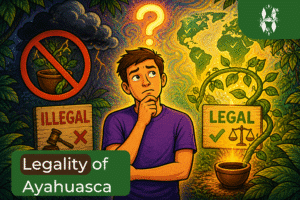
Where can I do ayahuasca legally?
Peru, Brazil, and Colombia are the primary legal destinations. In Colombia, yagé carries deep roots in the indigenous traditions of the Amazon. At Harmonica Retreat in Medellín, we work within the Colombian tradition with proper screening, facilitation, and post-ceremony support.