I’ve been facilitating ayahuasca ceremonies in Colombia for 5+ years. Once, leaving the retreat center after a ceremony, I was stopped by local police on a routine check. The officer looked at me, paused, and said — “ah, you’re the gringo who does the ayahuasca retreats” — not as an accusation, but as a statement of fact. We talked briefly, and I kept on my way.
That moment would be unimaginable in most parts of the world. In the UK, facilitating a ceremony is a potential Class A drug trafficking offense. In France, Santo Daime members have received suspended prison sentences for less. Even in countries retreat operators market as “safe and legal,” the reality is far more complicated than the brochure suggests.
The global legal landscape for ayahuasca is fragmented, frequently misunderstood, and consequential. This guide breaks it down fully — from countries where ayahuasca is constitutionally protected, through the gray zones where organizers carry real legal exposure, to jurisdictions where it remains flatly illegal — and why that distinction matters when choosing a retreat.
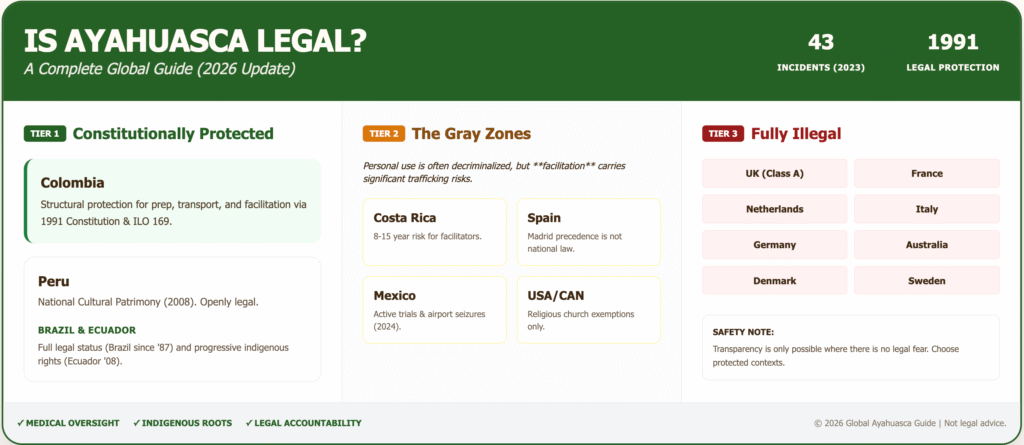
The Legal Spectrum — From Protected to Prohibited
Ayahuasca legality exists on a spectrum. At one end, countries where the practice is constitutionally protected as part of indigenous cultural heritage. At the other, jurisdictions where possession alone can result in criminal prosecution. Understanding where a country sits — and what that means for the people facilitating your experience — is one of the most important things you can do before booking a retreat.
Where Ayahuasca Is Legal and Culturally Protected
These are countries where protection runs deepest — not because of a court ruling that could be overturned, or a religious exemption limited to church members, but because ayahuasca is recognized as living indigenous cultural heritage, embedded in constitutional law and international treaty.
Is Ayahuasca Legal in Colombia?
Colombia has no single law explicitly legalizing ayahuasca — but also no law prohibiting it. What it has is something more structurally durable: a constitutional and indigenous rights framework that protects the practice at its roots.
Several legal instruments converge here:
- Article 7 of the 1991 Constitution recognizes and protects the ethnic and cultural diversity of the Colombian nation
- Ley 21 of 1991 adopted ILO Convention 169 into domestic law — the most binding international instrument on indigenous rights, covering traditional medicine practices
- OPIAC issues credentials to traditional medicine practitioners across six Amazonian departments, providing legal documentation used to protect facilitators during police stops
- The UNESCO Yuruparí designation (2011) — initiated by Colombia — recognized the shamanic knowledge of the jaguar shamans as Intangible Cultural Heritage of Humanity, with ayahuasca explicitly named in the nomination text
Critically, this protection extends beyond personal consumption. It covers preparation, transportation, and facilitation — the activities that carry legal risk for organizers in gray zone countries. That’s the fundamental difference.
Is Ayahuasca Legal in Peru?
In 2008, Peru issued National Directoral Resolution No. 836/INC — declaring ayahuasca National Cultural Patrimony and recognizing it as a living expression of national identity requiring active preservation. Ceremonies are fully legal for locals and foreigners alike, retreat centers operate openly, and the government has an active interest in protecting rather than prosecuting the practice. The Shipibo lineage has produced some of the world’s most experienced practitioners. The caveat: popularity has created a market where standards vary enormously. Legal protection doesn’t guarantee a safe or ethical retreat.
Is Ayahuasca Legal in Brazil and Ecuador?
Brazil has the clearest legal status globally — ayahuasca has been fully legal since 1987, when CONFEN removed it from the list of prohibited substances, reaffirmed by CONAD in 2010 with a formal regulatory framework. Ecuador’s protection, like Colombia’s, flows through indigenous cultural rights anchored in its progressive 2008 Constitution, with retreat centers operating openly in the Amazon region.
The Gray Zone — Tolerated But Not Protected
These are countries where personal consumption is decriminalized or largely unenforced — but where running a retreat operation enters categorically different legal territory. The moment ayahuasca moves from personal use into preparation, transportation, and facilitation for paying participants, it can be reframed as production and distribution of a controlled substance. Enforcement is inconsistent, but inconsistent enforcement is not the same as legal protection. This is also why retreat centers in these countries can occasionally receive a visit from local police.
Is Ayahuasca Legal in Costa Rica?
Frequently misrepresented as a legal destination. DMT is a controlled substance under Law 8204, and while personal possession is decriminalized, sale, distribution, transport, and charging for ceremonies fall under trafficking laws carrying 8 to 15 year sentences. The Ministry of Health issued formal warnings in both 2022 and 2025. Organizers here have no constitutional framework to invoke, no indigenous cultural rights to cite, and no regulatory status to stand behind. That exposure ultimately affects everyone present.
Is Ayahuasca Legal in Spain?
One of Europe’s most active ayahuasca markets. Ayahuasca is not listed as a controlled substance under Spanish law, and Ruling 316/2025 from the High Court of Justice of Madrid confirmed this — acquitting a defendant whose shipment was seized at Madrid-Barajas Airport in 2021. A significant precedent, but not a green light. The ruling applies only within Madrid’s jurisdiction. ICEERS has explicitly cautioned against reading it as national legalization. Organizers facilitating ceremonies for paying participants still carry real legal exposure under drug distribution laws.
Is Ayahuasca Legal in Portugal?
Portugal decriminalized personal possession of all drugs in 2001, making participant risk negligible. A visible ceremony scene operates openly, particularly in Lisbon and the Alentejo. But decriminalization covers personal consumption only — sale, transport, and facilitation remain criminal offenses, and organizers carry the same exposure as elsewhere in the gray zone.
Is Ayahuasca Legal in Mexico?
Frequently marketed as fully legal. It isn’t. ICEERS documented four active trials for ayahuasca importation in Mexico in the first half of 2024 alone — including indigenous practitioners facing sentences of up to 25 years. The Mexican navy has made airport seizures, and 161 kilos were publicly announced as confiscated in 2022. The legal risk falls on facilitators and transporters, not participants at luxury retreat centers — but that gap between marketed safety and operational reality is significant.
Religious Exemptions — A Narrow Legal Path
In some countries where ayahuasca is illegal, specific religious organizations have won protection under freedom of religion legislation. These exemptions apply exclusively to recognized church members in defined ceremonial contexts — not to retreat participants or the general public.
Is Ayahuasca Legal in the United States?
Two landmark cases shaped the landscape. In 2006, the Supreme Court ruled unanimously in Gonzales v. UDV that the União do Vegetal church could legally import and use ayahuasca under the Religious Freedom Restoration Act. In 2009, Judge Owen Panner issued a permanent injunction protecting Santo Daime members in Oregon. Several US cities have since decriminalized entheogenic plants at the municipal level. For everyone else, ayahuasca remains a Schedule I controlled substance under federal law.
Is Ayahuasca Legal in Canada?
DMT is illegal under the Controlled Drugs and Substances Act. As of 2020, six religious organizations hold formal exemptions — beginning with Santo Daime Church Céu do Montréal in 2017. As in the US, protections are strictly limited to church members in ceremonial contexts.
Where Ayahuasca Is Fully Illegal
No cultural protection, no decriminalization, no religious exemption for the general public. Participants and organizers carry real criminal exposure with no legal framework to fall back on. Most countries not listed in this guide — particularly across Asia, the Middle East, and Africa — likely fall into this category as well. If you are considering attending a ceremony in a country not mentioned here, treat it as illegal until verified otherwise through a credible local legal source.
Country | Notes |
United Kingdom | DMT is Class A — highest category under the Misuse of Drugs Act |
France | Plants classified as stupéfiants since 2005. Santo Daime members convicted in 2024 |
Netherlands | Ruled illegal by Supreme Court in 2019, overturning prior Santo Daime exemption |
Australia | DMT is Schedule 9 — possession, production, and import all prohibited |
Denmark | Supreme Court rejected Santo Daime religious exemption claim |
Sweden / Norway | Preparation of plants containing scheduled substances explicitly prohibited |
Ireland | 2014 religious exemption attempt failed |
Italy | Formally declared illegal in 2022 |
New Zealand | Class A drug under the Misuse of Drugs Act 1975 |
ICEERS’ Ayahuasca Defense Fund handled 43 legal incidents across fifteen countries in 2023 alone — reflecting not just enforcement activity but the human cost of operating without legal protection.
How Legality Affects the Safety of Your Retreat
Most people booking a retreat focus on the facilitator, the setting, the price. Legality is an afterthought. It shouldn’t be.
The legal risk in most jurisdictions falls on the organizer, not the participant — but that cuts both ways. When an organizer operates without genuine legal protection, a police visit during a retreat lands on everyone present. There is a meaningful difference between a retreat existing in a gray zone where nobody is currently looking, and one operating within a framework already tested under real conditions.
Retreats with genuine legal protection also tend to be the same retreats that operate openly and accountably — named facilitators, medical screening, physician oversight. Transparency is only possible when there is nothing to hide legally.
Personal Experience — 5+ Years Facilitating in Colombia
Before founding Harmonica Retreat, I attended ceremonies in gray zone countries as a participant. The experiences were meaningful — but underneath each one was a minor, persistent unease. Not about the medicine. About the context.
That unease became concrete when a fellow participant sent me pictures of a police presence at a Retreat in Spain. I’ve since heard of cases where unhappy participants informed authorities about retreat operations in gray zone countries — a vulnerability no facilitator skill can fully protect against. Many gray zone operators carry significant financial backing specifically for potential legal disputes. That told me everything about the environment they’re working in.
When building Harmonica Ayahuasca Retreat in Colombia, I didn’t want that uncertainty — and didn’t want to extend it to the people coming to work with us. What I chose instead has proven itself simply. Over five years, local police have stopped me multiple times. They know who I am and what we do. On one occasion, Sergio and I were stopped while transporting the medicine — the officers noticed it, we confirmed what it was, and we continued on our way. The Colombian police are aware that ceremonies are happening. That awareness, rooted in a constitutional framework protecting indigenous plant medicine since 1991, is the foundation we build on.
Questions to Ask Before You Book
- What is the actual legal basis for this retreat’s operation?
- Is the facilitator operating openly with verifiable credentials?
- Is there medical oversight on site?
- What happens if something goes wrong — legally, medically, psychologically?
A Note on the Future of Psychedelic Legislation
The legal landscape for plant medicines is shifting. Psilocybin has been legalized for supervised therapeutic use in Oregon and Colorado and approved for regulated medical access in Australia, New Zealand, and Canada, driven by a compelling body of clinical research showing meaningful improvements in depression, PTSD, and addiction. Other entheogenic substances are following a similar trajectory. The underlying logic is becoming harder to ignore: these are not recreational drugs in the conventional sense, but ancient medicines with demonstrated therapeutic potential that modern science is only beginning to understand.
Ayahuasca deserves the same trajectory. In February 2026, Imperial College London published results from a Phase IIa randomized controlled trial showing that a single dose of DMT — the primary psychoactive compound in ayahuasca — produced significant and lasting reductions in depressive symptoms compared to placebo, with effects persisting up to six months. The Centre for Psychedelic Research at Imperial continues to expand its work across depression, addiction, and other conditions. Johns Hopkins has published similarly promising findings with psilocybin. The evidence base is growing — and it increasingly supports what indigenous practitioners have known for centuries.
We hope that as research advances and attitudes continue to shift, ayahuasca will become more widely accessible under robust, culturally sensitive legal frameworks that protect both participants and the traditions that carry this medicine. Until then, understanding the legal landscape — and choosing accordingly — remains the most important first step.
What This Means for Your Decision
Most people searching for a retreat start from where is this available near me — not where is this most legally protected. That’s reasonable. Ceremonies exist under religious exemption, in gray zones, and in underground settings across the world. For many people in Europe or North America, traveling to Colombia or Peru represents a real additional commitment.
What this guide asks is that you make that choice consciously. A gray zone ceremony and a constitutionally protected one are not the same thing — not for the organizer, and by extension not for you. That doesn’t make one wrong and the other right. It means the contexts are different, and different contexts carry different considerations.
Only you can decide what constellation of factors — location, cost, legal framework, facilitator experience, cultural rootedness — works best for where you are and what you’re looking for.
Whatever you choose, choose it consciously. The medicine deserves that level of intention — and so do you.
Legal Disclaimer:
This article is intended for informational purposes only and does not constitute legal advice. The legal status of ayahuasca changes frequently and varies significantly by jurisdiction, local enforcement practices, and individual circumstances. Personal experiences shared reflect the author’s own situation in Colombia and should not be taken as representative of what others may encounter. We strongly recommend consulting a qualified legal professional familiar with the laws of the relevant country.
Frequently Asked Questions around legality of Ayahuasca
Is ayahuasca legal in Colombia?
Ayahuasca is not explicitly prohibited under Colombian law, and its practice is protected through indigenous cultural rights — including Article 7 of the 1991 Constitution, Ley 21, and ILO Convention 169. Colombia is one of the most legally secure destinations in the world for ayahuasca ceremonies.
Is ayahuasca legal in the US?
Under federal law, no — DMT is Schedule I under the Controlled Substances Act. The UDV and Santo Daime hold court-granted religious exemptions. Several cities have decriminalized entheogenic plants, but this does not legalize ayahuasca for general retreat participation.
Is ayahuasca legal in Spain?
Ayahuasca is not listed as a controlled substance under Spanish law, and a 2025 Madrid court ruling confirmed this. However the ruling applies only within Madrid’s jurisdiction and does not constitute national legalization. Organizers still carry real legal exposure.
Is ayahuasca legal in Mexico?
Technically unscheduled, but enforcement tells a different story. ICEERS documented four active importation trials in the first half of 2024, with indigenous practitioners facing up to 25 years. Mexico carries some of the highest practical risk of any country marketed as a safe destination.
Is ayahuasca legal in the UK?
No. DMT is a Class A drug — the highest category under the Misuse of Drugs Act. Possession, distribution, and facilitation all carry serious criminal penalties.
What is the safest country for an ayahuasca retreat?
Colombia, Peru, and Brazil offer the strongest legal foundations. Colombia’s framework is particularly robust as protection extends to preparation, transportation, and facilitation — not just personal consumption.
As a participant, am I at legal risk attending a ceremony?
In most gray zone countries, personal consumption carries minimal risk. The exposure falls primarily on organizers. However a police visit during a retreat affects everyone present — choosing a legally protected retreat removes that uncertainty.
Can I bring ayahuasca home after a retreat?
No. Transporting ayahuasca across international borders is illegal in virtually every destination country. DMT is internationally scheduled under the 1971 UN Convention on Psychotropic Substances. Do not attempt to transport it.
Can I attend a ceremony through Santo Daime or UDV?
Both organizations hold legal exemptions in the US and Canada, but are religious communities — not retreat centers. If their spiritual framework genuinely resonates, it can be a meaningful legal path. If you are primarily seeking healing outside a specific religious context, a retreat in a legally protected destination is the more appropriate choice.
Resources
Legal & Policy
- ICEERS — Legal Status of Ayahuasca by Country — The most comprehensive country-by-country legal resource available
- ICEERS — Ayahuasca Defense Fund — Legal support for individuals facing prosecution for ayahuasca-related charges
- Wikipedia — Legal Status of Ayahuasca by Country — Useful country table with sourced references
- ICEERS — Can Ayahuasca Be Used Legally in Spain? (2025) — Analysis of the 2025 Madrid High Court ruling
- UN 1971 Convention on Psychotropic Substances — The international treaty framework underlying most national drug laws
Colombia Specific
- Colombia 1991 Constitution — Article 7 — Constitutional protection of ethnic and cultural diversity
- Ley 21 of 1991 — ILO Convention 169 — Colombia’s adoption of indigenous rights protections
- UNESCO — Knowledge of the Jaguar Shamans of Yuruparí — Intangible Cultural Heritage designation that includes ayahuasca
Research & Science
- ICEERS — Ayahuasca Technical Report (2021) — Comprehensive scientific review signed by ten leading researchers
- Frontiers in Neuroscience — Psychotherapeutic Processes Associated with Ayahuasca — Peer-reviewed model for therapeutic use implications