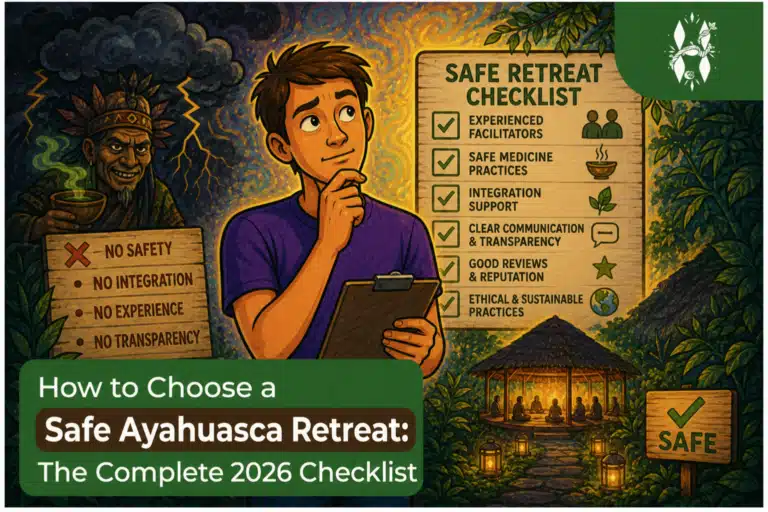
How to Choose a Safe Ayahuasca Retreat: The Complete 2026 Checklist

Knowing how to choose a safe ayahuasca retreat is one of the most important decisions a person can make before sitting with the medicine. The difference between a retreat that holds you safely through a challenging night and one that leaves you unsupported – or worse, in genuine danger – is not always visible in the marketing. I’m Oliver Glozik, founder of Harmonica Retreat in Medellín, Colombia. Over five years and more than 1,000 ceremonies, I’ve seen how dramatically the quality of a retreat center shapes what a participant experiences and takes home. I’ve also been approached by people who had difficult or unsafe experiences elsewhere, looking for repair. This guide is not a pitch for Harmonica. It is what I would tell anyone who asked me: here is how to evaluate a retreat honestly, what to look for, what should make you walk away, and what questions to ask before you hand over a deposit. The 5 Non-Negotiable Safety Standards These are not optional. Any retreat that does not meet all five of these standards has not yet earned the right to hold space for your ceremony. There are no exceptions based on price, reputation, or tradition. 1. Medical Screening Before You Book A legitimate retreat will not accept you without understanding your medical history. This includes current and recent medications (especially SSRIs, SNRIs, and any MAO-inhibiting drugs), mental health diagnoses, cardiovascular conditions, and family history of psychosis or schizophrenia. For a full overview of conditions that require extra caution or disqualify participation, see our guide on who should not do ayahuasca. The MAOI content of ayahuasca creates real, pharmacological contraindications that can be life-threatening if ignored. At Harmonica, every participant completes a detailed intake form before their place is confirmed. In some cases we request a conversation with a doctor. We have declined participants – not because we didn’t want their business, but because participating would not have been safe for them at that time. ⚠️ Red flag: Instant online booking with no health questionnaire. If a retreat accepts payment before asking about your medications, that is a serious safety failure. 2. Named, Verifiable Facilitators You should be able to find out who will be leading your ceremony before you arrive. This means named facilitators with backgrounds you can research – their training lineage, how long they have been working with the medicine, what tradition they come from, and whether participants who worked with them can speak to their experience. Facilitation in ayahuasca is not a credential you earn from a weekend course. It develops over years of ceremony, apprenticeship, and supervised practice. A retreat that keeps its facilitation team vague, rotates facilitators without notice, or presents a shaman with no verifiable background deserves skepticism. 3. A Clear Maximum Group Size The ratio of facilitators to participants matters enormously during ceremony. When twelve people are having simultaneous intense experiences in a dark room, each one deserves to be seen and supported. A group of forty cannot receive that quality of attention. Harmonica caps our ceremonies at fifteen participants, with a minimum of three experienced team members present. This is a deliberate operational decision that limits revenue but protects quality. If a retreat center doesn’t tell you their maximum group size, ask. If the answer is ‘it varies’ or ‘we accommodate everyone,’ ask more specifically. 4. Structured Integration Support The ceremony is not the end of the experience. What happens in the days and weeks afterward – how insights are processed, where confusion is held, what support exists for difficult material that surfaces – is often where the real healing either takes root or gets lost. Legitimate retreats include at minimum: a group integration circle the morning after ceremony, access to a facilitator for individual questions during the retreat, and post-retreat resources or follow-up. For a deeper understanding of what this process involves, see our guide on ayahuasca integration after ceremony. A retreat that packs you in, runs the ceremony, and sends you home with a smoothie and a receipt is providing entertainment, not facilitation. 5. Emergency Protocols That Are Stated, Not Just Implied Ask directly: what happens if a participant needs emergency medical care? The answer should include: proximity to a hospital or clinic, whether any staff have first aid or wilderness first responder training, what the protocol is for a psychological emergency, and who decides when to call for outside help. This is not a morbid question. It is a responsible one. A retreat that becomes evasive when you ask about emergency protocols is telling you something important. ✅ 10 Green Flags – What to Look For ✅Medical intake form is detailed and takes a minimum of 20-30 minutes to complete thoroughly ✅The retreat declines participants who don’t meet safety criteria – and communicates this clearly on their site ✅Facilitator names, photos, backgrounds, and training lineage are publicly available ✅Group sizes are stated clearly, with a maximum that allows meaningful individual attention ✅Integration support is described specifically – not just ‘we offer integration,’ but what form, when, and with whom ✅The retreat communicates honestly about what the experience may include – difficulty, purging, intense emotions – without only marketing the positive ✅Reviews include specific details about the team, the setting, and how the retreat handled difficult moments – not just generic praise ✅A pre-retreat preparation call or consultation is offered or required before arrival ✅The retreat is transparent about legal status in its country and makes no attempt to obscure its location ✅Clear, written policies on deposits, cancellations, and rescheduling are provided before payment 🚩 8 Red Flags – When to Walk Away 🚩No medical intake form or health questionnaire before booking is accepted 🚩The shaman or facilitator is presented as ‘the only real healer’ or uniquely qualified – without verifiable background 🚩Promises of specific outcomes: guaranteed healing, transformation, or results 🚩Group sizes of 25+ with unclear staff ratios 🚩Pressure to drink more during ceremony – ‘you’re not purging enough’ or ‘your ego is resisting’ as
Women’s Ayahuasca Retreat Guide: Safety & What to Look For (2026)
Want to choose the right Ayahuasca retreat for you as a women? Then read this guide! An Ayahuasca retreat can be one of the most transformative experiences of your life. As women, we have specific needs and considerations in these environments. We’re more in tune with certain dynamics, safety concerns, emotional intimacy, and our bodies’ natural cycles. There are things we don’t always think to check until we’re already in the retreat. In this guide, I share some considerations and guidance to provide you with clarity, so you can choose a retreat where you feel safe, supported, and comfortable as a woman. Key takeaways: Ayahuasca Safety Guide for Women A female facilitator in the space makes a big difference. Women understand women — how we process emotions, what helps us feel safe in ceremony, sharing circles and 1-1 conversations. It’s important to also heal in the presence of grounded, respectful men. Positive male facilitators — and even fellow participants — can help rebuild trust, safety, and confidence. Romantic situations, your period, and the comfort of the space can all influence your experience. Choose a retreat that respects boundaries, honors women’s cycles, and maintains a clean, organized space. Table of Contents A Guide for the Feminine Journey The Ayahuasca Safety Guide for Women Choosing a retreat where you feel safe, supported, and seen. Female Facilitation Women understand women. A female presence supports balance and safety. Healthy Masculinity Healing around grounded men helps rebuild trust. Clear Boundaries Respect for cycles, space, and consent is essential. 01. The Vetting Process Research Checklist Female facilitators present Pre-retreat communication available Honest 2–4 star reviews read Third-party reputation verified Trust Your Gut “Do their answers feel caring — or transactional?” 02. Why Female Presence Matters In Ceremony Practical and emotional support in vulnerable moments. In Sharing Subtle emotional cues are often better recognized. 1-1 Support Safe discussion of intimate, female-specific topics. Healing Around Men Healthy masculine presence can help restore nervous system safety. 03. Boundaries & Romance Avoid Mixed Signals • Late-night private talks • Extended physical closeness • Romantic language • Private room invitations Red Flags • Ignoring consent • No reporting process • Lack of accountability Ayahuasca & Your Cycle Sensitivity can increase during menstruation. Communication matters. Pro-tip: Ask centers about dosage flexibility. 04. The Physical Container Cleanliness Private Spaces Clear Transport Nurturing Activities Final Reflection Awareness is empowerment. Trust calm, clarity, and your intuition. Safety First • Healing Always Do your research to avoid unsafe situations as a woman at an Ayahuasca Retreat First is safety. On the internet (and through word of mouth) you’ll find plenty of warning stories— about opportunistic shamans or facilitators. These stories deserve your attention, as they can navigate you away from the wrong people to the right people. At the same time, remember that these bad eggs are in the minority – don’t let it taint your view of all shamans or all retreats. The most negative stories are shared most on the internet, and in reality, the majority of Ayahuasca retreats are safe, respectful, and beautiful. When doing your research, check: Are there female facilitators on the team? Can you meet or speak with the team ahead of time? Check reviews and testimonials from others—the experience of people who have been there before speak louder than the retreat center. Also not just 5-star reviews, but check the 2–4 star reviews. These are often the most honest. Search on multiple platforms—Google, Reddit, etc. Do they have experienced staff with a good reputation? Establish Trust With the Retreat Center Reach out and have real conversations with the retreat center / team before you book. Ask the harder questions, see how they respond. Get your Ayahuasca safety checklist below. Pay attention not just to their answers, but how they answer. Follow your gut feeling, and if the energy feels right to you. Do you feel seen, supported, and cared for—or do you feel like they just want to sell you a ticket? Support by female facilitators at an Ayahuasca Retreat When choosing an Ayahuasca retreat, one of the most overlooked considerations is if there will be a female facilitator present in the retreat. Why is this important? Ayahuasca takes you into a very open, sensitive state. If you don’t feel safe, you can’t fully let go. A female facilitator knows what it’s like to be a woman drinking Ayahuasca for the first time, and how to create a safe space both in and out of ceremonies in order to help you to trust and surrender in your process with the medicine. Women understand women There are certain experiences that as women we intuitively understand without needing to explain much to each other. It can be from as big as having shared traumatic experiences relating to men, to as small as what makes us laugh. Female facilitator in the Ayahuasca ceremony A grounded female presence in the ceremony can provide a reassuring energy; it tends to be more warm, nurturing and maternal. Her energy brings more of a balance to too much masculine energy. In ceremonies there are moments when women need very practical help, and having a female facilitator is more appropriate. For example if you need help going to the bathroom, if you need physical support, for someone to sit with you and hold your hand, if you need help to change your clothes etc. At Harmonica we intentionally have at least one female facilitator in every retreat and ceremony (often two) and it brings a good balance to the energy of the ceremony. Female facilitator in the sharing circles When a female facilitator is present in the sharing circles and she shares her perspective and insights, it can resonate differently and more deeply for women in the group. A lot of our experiences in life are shared human experiences that men also understand / go through. But certain experiences are only shared by women, and in these cases the way we process things can’t be understood
Weed and Ayahuasca: 5 Ways They Pull You Apart (2025)
Discover how weed and ayahuasca pull in opposite directions with safety-first retreat guidance—learn real risks, when to stop, and read before you drink.
What to Know Before Drinking Ayahuasca: 30 Truths (2026)
Learn what to know before drinking ayahuasca: release expectations, prepare body and mind, choose a trusted retreat, and set up support for integration.
Ayahuasca Dosage Guide | 15+ Years Safe Ceremony Support
Discover how Ayahuasca dosage works—ml, cups & traditions. Backed by 15+ years of experience, safe guidance & personalized support.
Ayahuasca told me… Can Ayahuasca Help Me Make a Decision?
Discover clarity through Ayahuasca. Learn how plant medicine supports decision-making, self-trust, and integration into everyday life.
Ayahuasca preparation: How to prepare for your ayahuasca ceremony
Ayahuasca has the potential to guide you on an incredibly profound journey, but this can only happen if you’re willing to meet the experience with openness and commitment. Also it is important to prepare for this experience. By engaging in thorough preparation, you demonstrate your readiness to explore your innermost depths and face the challenges that may arise along the way. Preparing for an Ayahuasca ceremony means not only following the dietary and lifestyle guidelines but also nurturing your emotional, mental, and spiritual well-being. It involves creating the space for introspection, setting clear intentions, and cultivating a sense of trust in the process. This preparation helps you to dissolve the barriers that may otherwise hinder your progress and allows for deeper self-discovery and transformation. Ultimately, the level of preparation you undertake can mean the difference between a life-changing experience and one that barely scratches the surface of your potential for growth and healing. By taking the time to prepare, you honor the power of Ayahuasca, embrace the opportunity for transformation, and maximize the benefits that the ceremony can offer you. Key takeaways: Ayahuasca is a strong medicine, therefore it is important to prepare your body, mind and spirit for the experience. Different traditions have different ways of preparing for Ayahuasca. In Colombia the recommendation for the body are simple. One week before stop eating red meat and garlic 3 days before stop with lactose and coffee Don’t eat citrus fruits on the day of the ceremony. Of course abstain from drugs and medications that contradict Ayahuasca Stop your coping mechanism one week before your ceremony. Whatever you are doing when you are bored, angry, frustrated, lonely – in many cases scrolling on social media, eating sugar (you know for you what it is) – stop doing it. That forces you to start to be with yourself. Frequently Asked Questions How should I prepare my body for an Ayahuasca ceremony in 2025? Focus on simple dietary adjustments: avoid red meat, alcohol, caffeine, and processed foods. Eat clean, whole meals to support the medicine’s work. What foods should I avoid before an Ayahuasca ceremony? One week before: no red meat or garlic. Three days before: stop dairy and coffee. On the day of: avoid citrus fruits. Always avoid alcohol and drugs. How do I prepare mentally for Ayahuasca? Reduce distractions like social media or sugar cravings, spend time in meditation, and begin practicing being present with yourself. Why is spiritual preparation important for Ayahuasca? Approaching the ceremony with humility, respect, and clear intention deepens healing and aligns you with the medicine’s ancestral traditions. How long before a ceremony should I stop taking certain medications? Always consult a medical professional. Many antidepressants and other medications can be contraindicated and should be tapered off with guidance. What coping mechanisms should I avoid before Ayahuasca? Stop habits like scrolling social media, eating sugar, or other distractions at least a week before. This creates space to sit with yourself honestly. Why travel to Colombia for Ayahuasca preparation? Colombia offers authentic ceremonies, experienced facilitators, and natural settings deeply connected to Ayahuasca’s tradition and lineage. Focus on simple dietary adjustments: avoid red meat, alcohol, caffeine, and processed foods. Eat clean, whole meals to support the medicine’s work. One week before: no red meat or garlic. Three days before: stop dairy and coffee. On the day of: avoid citrus fruits. Always avoid alcohol and drugs. Reduce distractions like social media or sugar cravings, spend time in meditation, and begin practicing being present with yourself. Approaching the ceremony with humility, respect, and clear intention deepens healing and aligns you with the medicine’s ancestral traditions. Always consult a medical professional. Many antidepressants and other medications can be contraindicated and should be tapered off with guidance. Stop habits like scrolling social media, eating sugar, or other distractions at least a week before. This creates space to sit with yourself honestly. Colombia offers authentic ceremonies, experienced facilitators, and natural settings deeply connected to Ayahuasca’s tradition and lineage. https://youtu.be/Q0Jcx9C8dGY Let’s start with who cannot drink Ayahuasca and what to avoid. Who should not drink Ayahuasca Ayahuasca is not suitable for everyone, as certain individuals may face increased risks or negative interactions when participating in Ayahuasca ceremonies. It’s crucial to be aware of these contraindications to ensure the safety and well-being of all involved. Antidepressants (especially SSRIs) Individuals currently taking antidepressants should abstain from Ayahuasca due to the potential for dangerous interactions between the plant medicine and their prescribed medication. Both Ayahuasca and many antidepressants affect the levels of serotonin in the brain, which could lead to a life-threatening condition called serotonin syndrome. This risk is particularly high for those taking selective serotonin reuptake inhibitors (SSRIs) or monoamine oxidase inhibitors (MAOIs). Heart / respiratory disease Individuals with pre-existing heart conditions and respiratory diseases (in many cases,,, asthma is ok, make sure you consult with a professional) should also exercise caution and consult with their healthcare provider before considering Ayahuasca. Ayahuasca is known to increase heart rate and blood pressure, which could exacerbate existing heart problems or create new ones in susceptible individuals. People with psychiatric conditions Individuals with psychiatric conditions, particularly bipolar disorder, borderline personality disorder and schizophrenia should refrain from participating in an Ayahuasca. Epilepsy Epilepsy is another medical condition that that is a contraindication to participating in an Ayahuasca ceremony. What should I avoid before drinking Ayahuasca: Hard drugs Individuals who are currently using hard drugs should avoid Ayahuasca ceremonies. The presence of these substances in the body can create unpredictable and potentially harmful reactions when combined with Ayahuasca, jeopardizing the safety of the experience. Cannabis, alcohol and cigarettes One important recommendation is to abstain from alcohol, cannabis and cigarettes for a week before the ceremony. This pause allows your body and mind to clear any lingering effects and prepares you to fully engage with the Ayahuasca journey in a more focused and present state. Psychedelic substances Mixing various psychoactive compounds can result in unpredictable reactions, potentially overwhelming the individual or even leading to
Ayahuasca and SSRIs: Doctor-Led Safety
Discover the healing power of Ayahuasca. Learn how surrender, trust, and safe guidance turn fear of losing control into transformation.
Losing Control on Ayahuasca
Discover the healing power of Ayahuasca. Learn how surrender, trust, and safe guidance turn fear of losing control into transformation.
Who Should Not Do Ayahuasca? A Thoughtful Guide for 2026

Ayahuasca can be a profound catalyst for healing and transformation, but it demands careful consideration of safety and readiness. The contraindications outlined in this article—from medical conditions and medication interactions to emotional preparedness—exist to protect individuals from potentially serious harm. Key takeaways: Medical safety first: Conditions like heart disease, epilepsy, and certain psychiatric disorders require absolute caution Medication interactions can be life-threatening: Never combine ayahuasca with SSRIs, MAOIs, or stimulants without proper medical guidance Emotional readiness matters: Approaching ayahuasca with genuine intention, personal motivation, and willingness to do ongoing work is essential Individual assessment is crucial: Every person’s situation is unique and requires professional evaluation FAQ Who should not drink Ayahuasca? People with certain medical or psychiatric conditions, or those taking contraindicated medications, should not drink Ayahuasca. This includes (but is not limited to) individuals with heart disease, epilepsy, severe respiratory illnesses, schizophrenia, bipolar disorder, or borderline personality disorder. What are the medical contraindications for Ayahuasca? Medical contraindications include (but are not limited to) cardiovascular disease, severe respiratory illness, epilepsy, and recent major surgeries. These conditions can increase the risk of serious complications during an Ayahuasca ceremony. Can people with psychiatric conditions drink Ayahuasca? Not all psychiatric conditions are strict contraindications. Severe conditions such as schizophrenia, bipolar disorder, and borderline personality disorder are considered unsafe, as Ayahuasca can destabilize them. Other conditions like depression or PTSD may be approached more cautiously, depending on the individual and the support provided. Is it safe to drink Ayahuasca if I take antidepressants? Most antidepressants, especially SSRIs, are unsafe with Ayahuasca because they can cause dangerous interactions like serotonin syndrome. Never stop or adjust your medication on your own—consult a qualified doctor familiar with Ayahuasca. Can I take Ayahuasca while on ADHD medications like Ritalin or Vyvanse? ADHD stimulants such as methylphenidate (Ritalin) or lisdexamfetamine (Vyvanse) are contraindicated with Ayahuasca. They overstimulate neurotransmitters and may cause life-threatening blood pressure spikes when combined with the MAOIs in Ayahuasca. Do I need to stop all medications before drinking Ayahuasca? No. A common misconception is that you must stop all medications. In reality, some medications are dangerous to combine with Ayahuasca, while others must be continued for safety. Always consult a doctor experienced with Ayahuasca to determine what applies in your case. Can Ayahuasca be dangerous after surgery? Yes. Drinking Ayahuasca shortly after surgery is unsafe because your body is still healing, and the strain of the medicine can complicate recovery. Always allow enough healing time and consult a doctor before considering a ceremony. Is Ayahuasca safe for people with autism, OCD, or PTSD? It depends on the individual. While these conditions are not strict contraindications, they often require specialized retreat settings and tailored support. For some people with autism, severe OCD, or complex PTSD, a standard retreat may not provide the right environment. Careful evaluation of each person’s situation is essential. People with certain medical or psychiatric conditions, or those taking contraindicated medications, should not drink Ayahuasca. This includes (but is not limited to) individuals with heart disease, epilepsy, severe respiratory illnesses, schizophrenia, bipolar disorder, or borderline personality disorder. Medical contraindications include (but are not limited to) cardiovascular disease, severe respiratory illness, epilepsy, and recent major surgeries. These conditions can increase the risk of serious complications during an Ayahuasca ceremony. Not all psychiatric conditions are strict contraindications. Severe conditions such as schizophrenia, bipolar disorder, and borderline personality disorder are considered unsafe, as Ayahuasca can destabilize them. Other conditions like depression or PTSD may be approached more cautiously, depending on the individual and the support provided. Most antidepressants, especially SSRIs, are unsafe with Ayahuasca because they can cause dangerous interactions like serotonin syndrome. Never stop or adjust your medication on your own—consult a qualified doctor familiar with Ayahuasca. ADHD stimulants such as methylphenidate (Ritalin) or lisdexamfetamine (Vyvanse) are contraindicated with Ayahuasca. They overstimulate neurotransmitters and may cause life-threatening blood pressure spikes when combined with the MAOIs in Ayahuasca. No. A common misconception is that you must stop all medications. In reality, some medications are dangerous to combine with Ayahuasca, while others must be continued for safety. Always consult a doctor experienced with Ayahuasca to determine what applies in your case. Yes. Drinking Ayahuasca shortly after surgery is unsafe because your body is still healing, and the strain of the medicine can complicate recovery. Always allow enough healing time and consult a doctor before considering a ceremony. It depends on the individual. While these conditions are not strict contraindications, they often require specialized retreat settings and tailored support. For some people with autism, severe OCD, or complex PTSD, a standard retreat may not provide the right environment. Careful evaluation of each person’s situation is essential. What Is Ayahuasca? From a Western perspective, Ayahuasca is a psychoactive brew traditionally prepared from two Amazonian plants: the Banisteriopsis caapi vine, which contains natural MAOIs, and the Psychotria viridis (chacruna) leaf, which contains DMT. Together, these plants create a visionary medicine that alters consciousness for 6–8 hours. Cleaveland Clinic From the indigenous viewpoint, however, Ayahuasca is far more than a chemical combination—it is a master plant teacher. For centuries, healers have described her as a conscious spirit who helps cleanse the body, illuminate hidden aspects of the psyche, and guide people toward deeper understanding of their lives. In this way, Ayahuasca is not only medicine but also a teacher, offering lessons in healing, clarity, and connection with nature. If you’re new to the medicine, start with our full guide on What is Ayahuasca to understand both its scientific and indigenous roots.” What Are the Benefits of Ayahuasca? Ayahuasca is often described as a powerful tool for healing and self-discovery. From a scientific perspective, studies suggest it may reduce symptoms of depression, anxiety, and PTSD, while promoting neuroplasticity and emotional regulation. Participants often report increased mindfulness, improved relationships, and a greater sense of purpose. From the indigenous viewpoint, the benefits go beyond psychology—Ayahuasca is seen as a spiritual teacher that cleanses the body, clears energetic blockages, and reconnects people with
Ayahuasca Retreat Cost in 2026: Complete Price Guide by Country

This guide covers what actually drives retreat costs, what’s included at each price point, and a full country-by-country comparison across Colombia, Peru, Costa Rica, Ecuador, Brazil, Europe, and the USA. Ayahuasca retreat prices vary more than almost any other healing journey you can book — from $40 for a rustic local ceremony in Colombia to $8,000 for a luxury week in Costa Rica. For someone doing research for the first time, this range is genuinely confusing. It can make you wonder whether the expensive retreat is safer, whether the cheap one is a scam, or whether price is any indicator of quality at all. It isn’t. Not directly. A safe, authentic, deeply transformative ayahuasca experience is very possible in the $1,500–$2,500 range for a one-week retreat. What matters is the experience and integrity of the facilitators, the screening process, the group size, and the quality of integration support — not the price tag or the infinity pool. Who we are: We run Harmonica Retreat, one hour from Medellín, Colombia — a medically supervised center with a maximum group size of 12 and hundreds of five-star reviews. Our 4-day retreat starts at $695 (2 ceremonies) and our 7-day retreat at $1,435 (4 ceremonies) — competitively priced without compromising on safety or quality. https://youtu.be/lckdZF_ESbU?si=SKibLmhttlil5eVw What Factors Determine the Price of an Ayahuasca Retreat? Understanding why retreat prices vary so dramatically starts with understanding what you are actually paying for. What drives the cost is everything around Ayahuasa — the people, the place, the preparation, and the support. Location and Legal Status Where a retreat operates has one of the biggest impacts on price. In countries like Colombia, Peru, Ecuador, and Brazil, ayahuasca is legal and deeply rooted in indigenous tradition. Lower costs of living, proximity to the medicine’s origins, and established local infrastructure all keep prices more accessible. In contrast, retreats in Costa Rica, Europe, and the USA operate in higher-cost environments. European centers often fly shamans in from Peru or Colombia, adding significant logistical costs. In the USA, most centers operate under religious exemptions with considerable legal and operational overhead. All of this gets reflected in the price. Duration and Number of Ceremonies The longer the retreat and the more ceremonies included, the higher the total cost — though the cost per ceremony often decreases with longer programs. Duration also affects depth. Short retreats of 2–3 days leave little time for preparation, integration between ceremonies, or processing what arises. Most experienced facilitators recommend a minimum of 4–5 days, with 7 days being the most common format for good reason. Accommodation Type Shared accommodation is the most budget-friendly option and perfectly adequate for most retreats — but “shared” covers a wide spectrum. There is a significant difference between a 4-person room with proper beds and a hostel-style dormitory of 8–12 people, often not separated by gender. At the lower end of the market, it is also not uncommon for participants to sleep in the same space where ceremonies are held — a setup that affects both rest and the overall sense of safety and privacy. Private rooms or luxury bungalows can add several hundred dollars to the base price. For a first retreat, privacy can be valuable — but shared accommodation at a well-run center is far preferable to a private room at a poorly facilitated one. When comparing prices, always ask specifically what the sleeping arrangements look like. Facilitator Experience and Lineage This is arguably the most important cost driver — and the hardest to evaluate from a website. Facilitators with decades of experience, genuine lineage, and a track record of safely guiding people through difficult experiences command higher fees, and rightly so. Ask directly: how long have they been working with the medicine? What tradition do they come from? A reputable center will answer without hesitation. Group Size and Staff-to-Guest Ratio Smaller groups cost more per person but provide a meaningfully different experience. A ceremony with 8–12 participants allows facilitators to attend to each person individually — something that matters when difficult experiences arise, as they often do. A facilitator-to-guest ratio of roughly 1:5 is a good standard. Anything above 1:10 warrants careful consideration. Preparation and Integration Support Centers that offer genuine preparation — medical screening, dietary guidance, intention-setting calls — and real post-retreat integration support invest significant staff time to provide it. Centers that include follow-up calls, integration circles, or ongoing coaching as part of their package are offering something more complete, and the price reflects that. The Real Cost of a Cheap Retreat The lowest-priced retreat is rarely the best value. Centers that charge very little are often making trade-offs somewhere — larger groups, less experienced facilitators, minimal screening, or no integration support. This doesn’t mean you need to spend $5,000 for a safe and transformative experience. It means price alone is a poor compass. The sections below will give you a clearer map. “In hundreds of conversations with people considering ayahuasca, I always ask what matters most to them. The overwhelming answer is safety — physical safety, yes, but even more so emotional safety. That is harder to quantify, but it comes down to the experience of the facilitators and the attention to detail in every aspect of the retreat — from the first message you receive, to the last goodbye.” – Oliver, Founder of Harmonica Retreat Tweet Colombia — Best Value for Authentic Ceremonies For many years Peru was considered the default destination for ayahuasca. That has changed. Colombia has become one of the most sought-after destinations for international seekers — and for good reason. It combines authentic indigenous lineages, accessible logistics for travelers from North America and Europe, and prices that remain among the most competitive of any organised retreat destination in the world. Ayahuasca — known locally as yagé — has been used ceremonially in Colombia for generations, particularly among the indigenous communities of the Putumayo region. This is not a transplanted tradition. It is medicine with deep roots in the land and
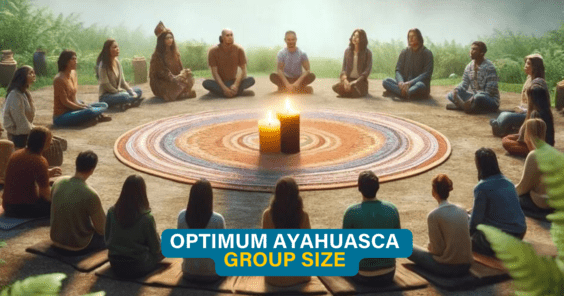
Ayahuasca group size
Finding the right group size for your Ayahuasca experience is a delicate balance of personal preference and the collective energies that different group dynamics bring. The dynamics of a small group compared to a larger one can significantly affect your experience. From the level of personal attention you receive as well as the energy and intimacy of the session. In this blog, we dive into why the number of participants matters and how you can determine the ideal group size for your Ayahuasca experience. Key takeaways: Group energy impacts the shared spiritual journey, providing a space where participants can authentically connect, share vulnerabilities, and learn from each other. Emotional triggers during the retreat are opportunities for self-reflection and healing, where participants can explore deeper issues and learn from the reflections provided by others. Distractions during ceremonies are inevitable, especially in larger groups. Learning to focus amidst them mirrors challenges in daily life and can enhance personal resilience. The number of participants in an Ayahuasca retreat significantly influences the personal attention received and the overall energy, impacting the depth of one’s experience. Ayahuasca group size and energy Group energy plays a big role in the shared journey of an Ayahuasca ceremony. Being inherently social creatures, humans thrive on connection. This need for interaction starts from birth and extends through family life, education, and work environments. Many emotional challenges arise from feelings of separation or a lack of belonging. Participating in an Ayahuasca ceremony with others offers a unique opportunity to engage in a collective spiritual experience that emphasizes authenticity over social status or achievements. In the setting of a retreat, the usual masks people have – like the need to appear successful or worldly – fall away. Here, the focus shifts to personal growth and mutual support among participants. This environment allows participants to express themselves authentically, sharing their deepest fears, aspirations, and vulnerabilities without judgment. This kind of open sharing builds a deep sense of community and compassion. It’s a powerful reminder that we are not alone in our struggles; others face similar or even harder challenges. Hearing others’ stories can put our own problems into perspective, often making us realize that we might prefer our own set of challenges over those of others. Throughout the retreat, as participants reveal more about their inner lives, it becomes clear that there is always more beneath the surface. Navigating triggers from your Ayahuasca group Getting triggered by other group members during an Ayahuasca ceremony or retreat is more common than one might expect. These situations offer valuable opportunities for introspection and personal growth. When you find yourself emotionally impacted by someone you’ve known only briefly, it’s helpful to pause and reflect. Ask yourself: What is it about this person that triggers such a strong reaction? What or who do they represent to me? Often, the individuals who trigger us can act as mirrors, reflecting back the unhealed parts of ourselves. Allowing the trigger to serve as a teacher can be a profound exercise in self-discovery. Through the heightened states facilitated by Ayahuasca, you are given a chance to delve deep into your psyche, exploring the roots of your emotional responses. This process can reveal underlying issues or unresolved emotions, highlighting areas in need of healing. In this way, those who trigger us during these ceremonies can become some of our greatest teachers. Must read blog: Ayahuasca Preparation Distractions during your Ayahuasca ceremony Distractions are a natural part of any Ayahuasca ceremony, especially as the number of participants increases. For example, during a ceremony in the jungle, a person outside our group was going through an intense experience, screaming for hours. This situation was understandably frustrating, and there was a desire to minimize the disruption. When approached about the issue, my mentor Sergio, reminded me that such distractions are part of the ceremony. Just as distractions are a part of everyday life, they also manifest during these spiritual experiences. Sergio’s perspective highlighted an important lesson: the power of choice in where we place our attention. This insight was shared with the participants, helping everyone to refocus on their personal journeys. Understanding that distractions can be navigated and reframed as part of the experience helps participants to deepen their engagement with their own processes. It’s about learning to maintain focus amidst external chaos, which not only enhances the ceremony but also equips people with skills that are applicable in daily life. Ceremony consciousness with your Ayahuasca group “Ceremony consciousness” is a concept within Ayahuasca ceremonies suggesting that everything occurring during the session holds significance. This idea emphasizes the interconnectedness of individual and collective experiences within the ceremonial space. For example, if a person starts crying during a ceremony, this not only reflects their own emotional release but also becomes a catalyst for other participants’ reactions, each interpreting and responding to the situation based on their personal context and emotional state. One participant may feel concern, another sadness, or joy in witnessing someone’s breakthrough. Others might not notice at all, or feel annoyed by the distraction, or even envious of the emotional expression they perceive as lacking in their own experience. It also highlights the potential for Ayahuasca to mirror personal patterns, such as those who might prioritize others’ well-being over their own, revealing their tendencies to neglect personal introspection for external attentiveness. This variety of reactions illustrates how a single event within a ceremony can manifest multiple meanings and lessons, depending on individual perspectives. “Absorbing” other peoples’ energies in your Ayahuasca group A common concern among participants in Ayahuasca ceremonies is the fear of “absorbing” the energies of others, especially when they are in an open, receptive state. This worry is understandable. However, if the ceremony is led by a skilled Ayahuasca shaman, there’s generally no need for concern. A good shaman will continuously work to harmonize the space, ensuring that participants are not adversely affected by each other’s energies. Often, what participants perceive as negative energy in a ceremony may
How to Navigate a Difficult Ayahuasca Experience
Imagine: You are now in your Ayahuasca ceremony. And it is incredibly difficult, you feel overwhelmed… What do you do now? How do you handle the situation? Understanding how to navigate these difficult experiences is important, for your safety and wellbeing first and foremost, but also for realizing the growth that it can lead to. This article outlines 13 practical tips to help you navigate through challenging Ayahuasca ceremonies with confidence. Key takeaways Trust the facilitators and medicine. Knowing that you are in safe, experienced hands can allow you to surrender more fully to the experience. Remember: the experience is temporary. This can help you stay grounded and reduce anxiety during the ceremony. Be open to whatever insights or messages Ayahuasca may bring, even if they are hard. This can turn difficult experiences into opportunities for growth and understanding. https://youtu.be/cbNhrJ7I5S0?si=rbHdvmDGBxShDpTa Tip #1: This difficult Ayahuasca experience won’t last forever During a powerful Ayahuasca experience, it can feel like this intense state will never end, which can make one anxious about their mental state and sanity. But, remember that Ayahuasca experiences don’t last forever. Knowing that you will return to your normal state the next day can anchor you during the ceremony. It’s also helpful to know that often with Ayahuasca it reaches a peak and then starts to go down. What may feel overwhelming at one moment is going to ease within the next 30 minutes. Remind yourself that each moment of discomfort is temporary and that the journey is cyclical… what goes up must come down. Must read blog – Ayahuasca what to expect Tip #2: You are not going to die In an Ayahuasca ceremony you can even be confronted with death itself. And it can feel very real, not just like a simulation that I am going through in a ceremony. Know that if you’ve been medically cleared to participate – meaning no existing conditions like epilepsy, heart issues, recent surgeries, or psychiatric conditions, and are not on medications that alter brain chemistry – that you will be fine. In a way death is a great liberation. And in some ways we need to spiritually die to create a new life. This ‘death’ isn’t literal but represents the letting go of past traumas, outdated self-concepts, and destructive patterns. The idea is that the foundation is so rotten, that you cannot build the life you wish for on that foundation. And the foundation needs to be wiped clean – to make way for new growth. This process is challenging and demands a high level of trust in the experience and in yourself, but it can lead to incredible feelings of liberation and renewal. For example, after experiencing a symbolic death in a ceremony, many report feeling freed from burdens they’ve carried for years, ready to start anew with a clearer vision for their lives. This idea is similar to the Buddhist practice of maranasati, a meditation focused on contemplating one’s own death to achieve peace and clarity about life’s unresolved issues and to know what path to go on instead of mindessly living from one day to the next without a purpose. Similarly, Ayahuasca can facilitate a deep confrontation with death and the unresolved issues we carry, offering us a chance to resolve these and choose a more meaningful path forward. As we will look into further in this article, keeping an open mind to what Ayahuasca wants to show you and being thankful for the experience are important to navigating difficult experiences like spiritual death. Must read article: Ayahuasca Preparation – how to prepare for your Ayahuasca experience Tip #3: Focus on your breath during an intense Ayahuasca experience When facing an intense Ayahuasca experience, it’s common to feel the urge to react physically – move around a lot and abruptly, to fidget, make sudden movements, start saying random sentences. This physical restlessness can exacerbate the hectic energy, adding more fuel to it. In a way we can put ourselves in that energy. And the more we “feed” it with our movement, the more it amplifies. Instead, you can practice grounding yourself by sitting still and focusing solely on breathing. When we actually sit down, and focus on our breath, just taking one breath after the other, we still notice that the Ayahuasca is strong, but we also notice that it starts to be more manageable. Tip #4: Trust the Facilitators Trusting the facilitators you choose for your Ayahuasca ceremony is so important. If there’s a lack of trust, it’s advisable not to participate in a ceremony with those facilitators. Suspicion or fear, such as concerns about being harmed or exploited, can seep into your experience, potentially amplifying any underlying paranoia. This may seem like straightforward advice, but it’s so important to highlight to lead a safe and positive experience. The dynamics of trust in an Ayahuasca setting are complex. Sometimes, our own fears and apprehensions can project onto the facilitators. For instance, I’ve had participants tell me that they saw me as an angel, I have had participants tell me I looked like the devil. This had less to do with my own energy but more with what the participant was going through themselves. Obviously trying to calm down a participant while he thinks that you are the devil is not that easy. Trust your intuition and also know that sometimes you might be projecting your fears onto the situation. So again, really make sure you trust the place that you choose to do your ayahuasca ceremony at… Before committing, take the time to research, visit/interact with the retreat and its facilitators to confirm that it’s a place where you can be vulnerable and open to the journey. Find out if Ayahuasca is right for you Will you be safe physically and emotionally? How will you be supported in the ceremony? How do the facilitators handle difficult situations? How will you be able to process the experience? You want change, but will your life be
Can you Drink Ayahuasca During your Period?

Are you curious about whether you can drink Ayahuasca on your period? This is a question many women have as they prepare for their journey with this powerful plant medicine. Ayahuasca ceremonies are deeply transformative, but periods have their own set of physical and emotional dynamics. In this article, we’ll explore the considerations and cultural perspectives, and outline our approach to drinking Ayahuasca on your period. Key takeaways Our position: At our retreat center, we allow women on their periods to drink Ayahuasca. There are some extra guidelines around this such as starting with a smaller dose. Practical Preparations: If you decide to join a ceremony during your period, prioritize comfort and warmth. Bring extra blankets, wear loose clothing, and consider herbal teas like raspberry leaf for uterine support. Open communication with facilitators ensures you receive the appropriate guidance and support. Diverse Traditions and Beliefs: Different shamans have different views on participating while on your period. Understanding these can help you make an informed decision that respects both traditional beliefs and your personal needs. Ayahuasca and menstruation Deciding to participate in an Ayahuasca ceremony can bring up many personal questions, especially when it comes to natural body processes like menstruation. It’s a sensitive issue; some spiritual leaders and shamans advise against drinking Ayahuasca while menstruating, based on long-standing traditions, while others see no problem and welcome everyone. This mixed guidance can make things confusing. You might wonder: “Should I go if I’m on my period? What could happen if I do?” These questions are important not only for your physical health but also for fitting in smoothly with the group and respecting the ceremony’s traditions. When facing this decision, it’s essential to gather as much information as possible and consider everyone involved in the ceremony. Understanding both the traditional reasons behind these guidelines and the experiences of other women can help you make a choice that feels right. Remember, the decision to participate in an Ayahuasca ceremony during menstruation should be made with care, respecting both the old ways and your personal well-being, ensuring that your experience is respectful and meaningful for everyone involved. Must read blog What to expect in your Ayahuasca ceremony Different approaches to women participating in an Ayahuasca ceremony on their period The practices surrounding a woman on her period participating in Ayahuasca ceremonies can vary significantly, not just from culture to culture, but even among individuals within the same community. This diversity in practice highlights how personal and subjective these traditions can be. For instance, in some settings, she might be asked not to participate at all, while in others, special accommodations are made, such as providing a designated area away from the main ceremony space. The reasoning behind these different approaches often stems from a belief held by some that menstruation can obscure the visions of other participants, though opinions on this can widely differ. Individual viewpoints on women drinking Ayahuasca on their period For example, Mama Concha is known for her preference that women on their periods do not join her ceremonies. On the flip side, Taita Miguel takes a more inclusive approach. During a pre-ceremony discussion, when a participant brought up Mama Concha’s advice against drinking Ayahuasca while menstruating, Taita Miguel acknowledged the validity of that perspective for Mama Concha’s ceremonies but was quick to point out that his ceremonies operate under different beliefs. Similarly, another shaman named Juan once hosted a ceremony where he asked a woman on her period to not go near the altar, aiming to respect certain traditional beliefs. Contrastingly, Sergio, another respected shaman, challenges these norms. After a ceremony that included a participant on her period, he asked others if they felt any difference in their experience, using this as a teachable moment to suggest that much of the concern might be rooted in superstition. These varied examples underline the importance of respecting each medicine giver’s practices and the cultural nuances they bring to their ceremonies. For participants, being aware of these differences and engaging in open dialogue with the ceremony leaders can ensure that everyone’s journey with Ayahuasca is respected and fulfilling, harmonizing personal needs with communal and cultural expectations. Understanding cultural beliefs about menstruation and Ayahuasca ceremonies A belief in not mixing medicines The beliefs surrounding menstruation and participation in Ayahuasca ceremonies are deeply rooted in the cultural and spiritual frameworks of indigenous communities. Many cultures regard each phase of a woman’s menstrual cycle as spiritually significant, viewing it as a time for women to reflect on the past month’s stresses and challenges, which can potentially lead to heightened emotional states. Some traditions consider this introspective process as a natural medicinal period, suggesting that the profound personal insights and emotional cleansing it provides may eliminate the need for other spiritual medicines like Ayahuasca during this time. A belief reflecting patriarchal views Some suggest that these traditions may also reflect outdated gender norms, influenced by patriarchal values. Historically, women’s roles and rights were restricted in many societies, including indigenous ones, which could have shaped various cultural practices. For example, the restriction against women participating in ceremonies during menstruation might have been initially promoted by men who labeled women as emotionally unstable during their periods. This could have been a tactic to encourage women to focus on self-care, to prevent them from “contaminating” the communal experience, thus perpetuating a narrative that served to maintain control under the pretence of cultural tradition. This conversation highlights the importance of continuously evaluating our practices to ensure they remain respectful and inclusive, balancing traditional wisdom with a modern understanding of gender equality. How menstruation affects your Ayahuasca ceremony For women considering participating in an Ayahuasca ceremony during their menstrual period, it’s important to set realistic expectations and prepare for the experience, which can differ significantly from their usual menstrual cycle. First, it’s not uncommon for some women to experience an increased level of bleeding when they drink Ayahuasca during menstruation. This can be attributed to
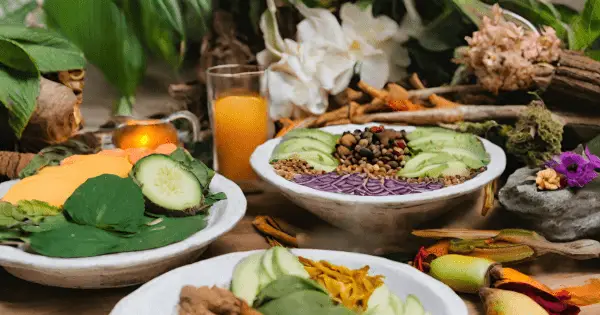
What can you eat on Ayahuasca Diet?

Understand the plant-based diet for spiritual receptivity and ancient wisdom. Embark on a transformative Ayahuasca journey, connecting mind, body, and spirit.