How to Choose a Safe Ayahuasca Retreat: The Complete 2026 Checklist
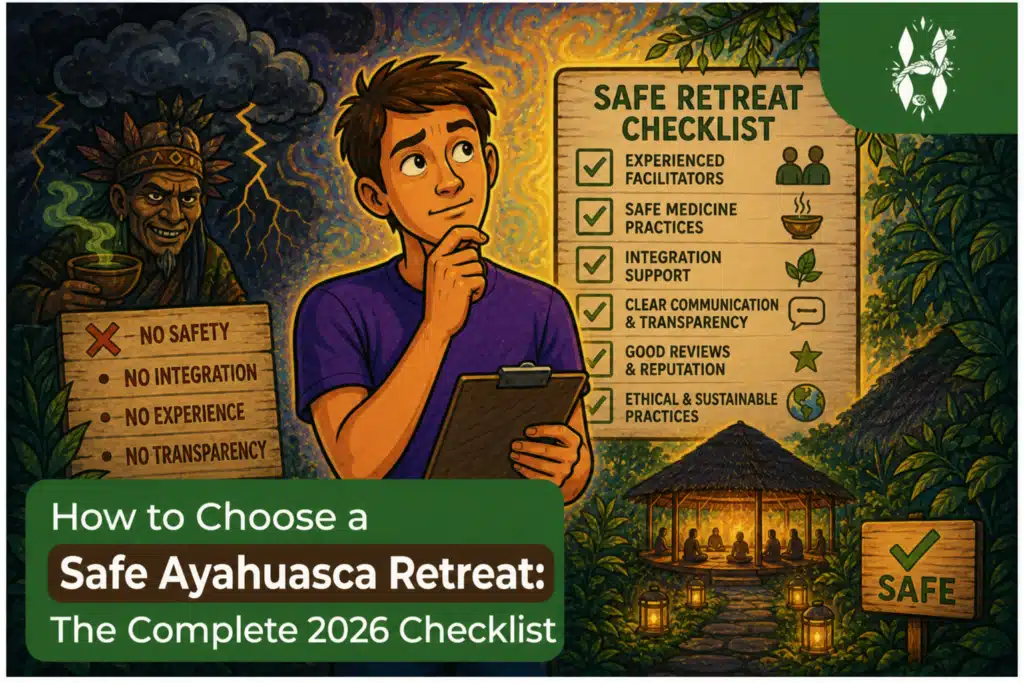
Knowing how to choose a safe ayahuasca retreat is one of the most important decisions a person can make before sitting with the medicine. The difference between a retreat that holds you safely through a challenging night and one that leaves you unsupported – or worse, in genuine danger – is not always visible in the marketing. I’m Oliver Glozik, founder of Harmonica Retreat in Medellín, Colombia. Over five years and more than 1,000 ceremonies, I’ve seen how dramatically the quality of a retreat center shapes what a participant experiences and takes home. I’ve also been approached by people who had difficult or unsafe experiences elsewhere, looking for repair. This guide is not a pitch for Harmonica. It is what I would tell anyone who asked me: here is how to evaluate a retreat honestly, what to look for, what should make you walk away, and what questions to ask before you hand over a deposit. The 5 Non-Negotiable Safety Standards These are not optional. Any retreat that does not meet all five of these standards has not yet earned the right to hold space for your ceremony. There are no exceptions based on price, reputation, or tradition. 1. Medical Screening Before You Book A legitimate retreat will not accept you without understanding your medical history. This includes current and recent medications (especially SSRIs, SNRIs, and any MAO-inhibiting drugs), mental health diagnoses, cardiovascular conditions, and family history of psychosis or schizophrenia. For a full overview of conditions that require extra caution or disqualify participation, see our guide on who should not do ayahuasca. The MAOI content of ayahuasca creates real, pharmacological contraindications that can be life-threatening if ignored. At Harmonica, every participant completes a detailed intake form before their place is confirmed. In some cases we request a conversation with a doctor. We have declined participants – not because we didn’t want their business, but because participating would not have been safe for them at that time. ⚠️ Red flag: Instant online booking with no health questionnaire. If a retreat accepts payment before asking about your medications, that is a serious safety failure. 2. Named, Verifiable Facilitators You should be able to find out who will be leading your ceremony before you arrive. This means named facilitators with backgrounds you can research – their training lineage, how long they have been working with the medicine, what tradition they come from, and whether participants who worked with them can speak to their experience. Facilitation in ayahuasca is not a credential you earn from a weekend course. It develops over years of ceremony, apprenticeship, and supervised practice. A retreat that keeps its facilitation team vague, rotates facilitators without notice, or presents a shaman with no verifiable background deserves skepticism. 3. A Clear Maximum Group Size The ratio of facilitators to participants matters enormously during ceremony. When twelve people are having simultaneous intense experiences in a dark room, each one deserves to be seen and supported. A group of forty cannot receive that quality of attention. Harmonica caps our ceremonies at fifteen participants, with a minimum of three experienced team members present. This is a deliberate operational decision that limits revenue but protects quality. If a retreat center doesn’t tell you their maximum group size, ask. If the answer is ‘it varies’ or ‘we accommodate everyone,’ ask more specifically. 4. Structured Integration Support The ceremony is not the end of the experience. What happens in the days and weeks afterward – how insights are processed, where confusion is held, what support exists for difficult material that surfaces – is often where the real healing either takes root or gets lost. Legitimate retreats include at minimum: a group integration circle the morning after ceremony, access to a facilitator for individual questions during the retreat, and post-retreat resources or follow-up. For a deeper understanding of what this process involves, see our guide on ayahuasca integration after ceremony. A retreat that packs you in, runs the ceremony, and sends you home with a smoothie and a receipt is providing entertainment, not facilitation. 5. Emergency Protocols That Are Stated, Not Just Implied Ask directly: what happens if a participant needs emergency medical care? The answer should include: proximity to a hospital or clinic, whether any staff have first aid or wilderness first responder training, what the protocol is for a psychological emergency, and who decides when to call for outside help. This is not a morbid question. It is a responsible one. A retreat that becomes evasive when you ask about emergency protocols is telling you something important. ✅ 10 Green Flags – What to Look For ✅Medical intake form is detailed and takes a minimum of 20-30 minutes to complete thoroughly ✅The retreat declines participants who don’t meet safety criteria – and communicates this clearly on their site ✅Facilitator names, photos, backgrounds, and training lineage are publicly available ✅Group sizes are stated clearly, with a maximum that allows meaningful individual attention ✅Integration support is described specifically – not just ‘we offer integration,’ but what form, when, and with whom ✅The retreat communicates honestly about what the experience may include – difficulty, purging, intense emotions – without only marketing the positive ✅Reviews include specific details about the team, the setting, and how the retreat handled difficult moments – not just generic praise ✅A pre-retreat preparation call or consultation is offered or required before arrival ✅The retreat is transparent about legal status in its country and makes no attempt to obscure its location ✅Clear, written policies on deposits, cancellations, and rescheduling are provided before payment 🚩 8 Red Flags – When to Walk Away 🚩No medical intake form or health questionnaire before booking is accepted 🚩The shaman or facilitator is presented as ‘the only real healer’ or uniquely qualified – without verifiable background 🚩Promises of specific outcomes: guaranteed healing, transformation, or results 🚩Group sizes of 25+ with unclear staff ratios 🚩Pressure to drink more during ceremony – ‘you’re not purging enough’ or ‘your ego is resisting’ as
