I also recorded a video about being afraid of ayahuasca and what to do with that fear:
Fear Before the Retreat: Doubts That Start Weeks Earlier
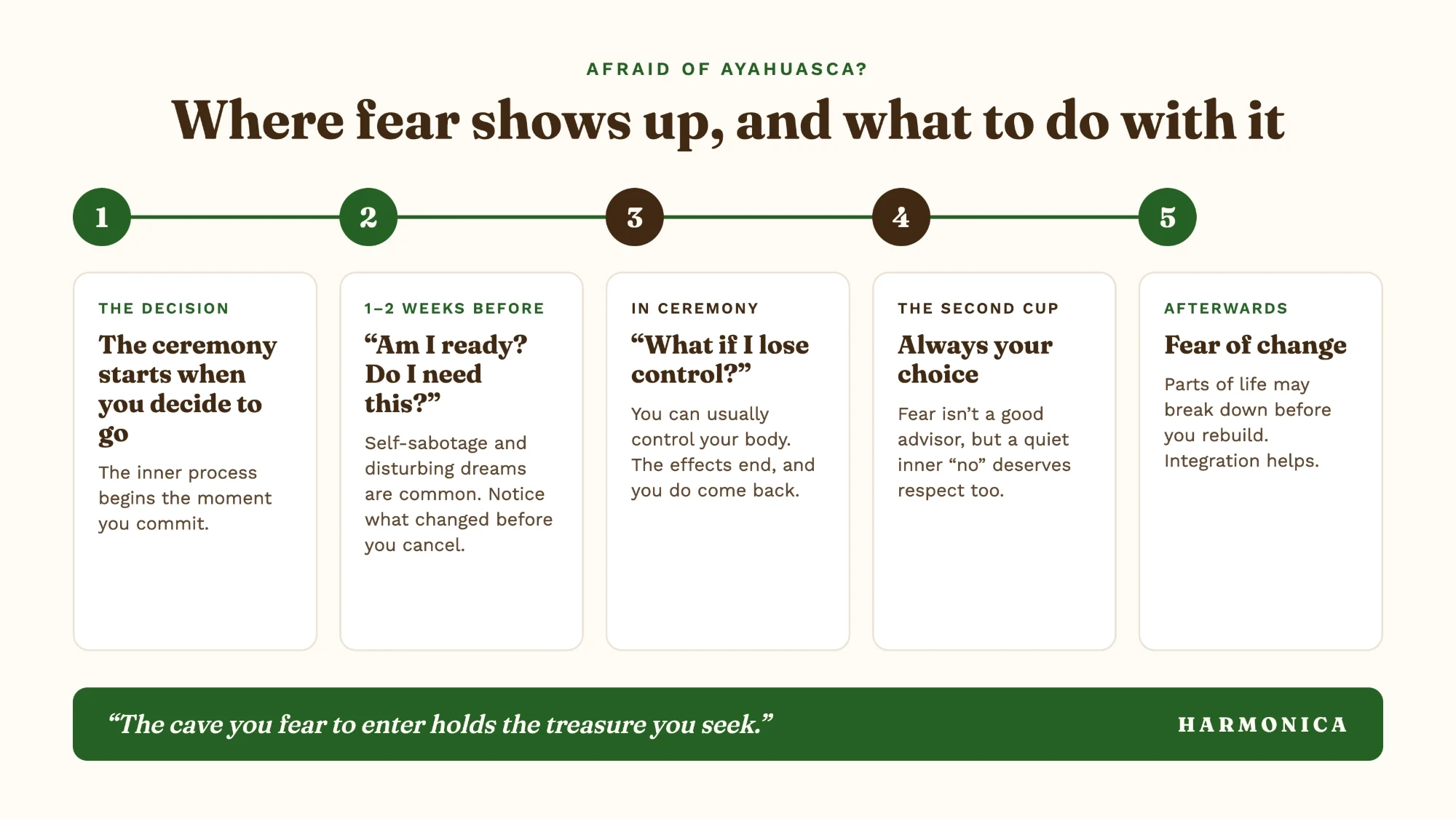
Fear before an ayahuasca retreat often begins one or two weeks before the ceremony. There is a common saying that the ceremony starts when you decide to attend. In a way, the internal process begins with that decision.
This is also when self-sabotage can appear. Your mind starts asking, "Am I ready? Do I need this? Will it be too intense?" These may be sincere questions, but they can also become logical-sounding reasons to escape something frightening.
If you felt clear and suddenly became scared, slow down and notice what changed. Disturbing dreams may also appear and add more doubt. Part of your preparation is noticing these reactions without treating every uncomfortable feeling as a warning.
One guest experienced this before the retreat had even started. Hearing from us that it was normal helped them understand the turmoil.
Obviously, this does not mean ignoring every doubt. Examine whether the fear points to a concrete risk or whether self-sabotage is pulling you back toward familiar territory.
Is Ayahuasca Right for You? A Personal Decision
Ayahuasca is not right for everybody, and the decision belongs to you. Some people hear about ayahuasca and immediately know they have no desire for such an intense, inward experience. Their choice deserves respect because plant medicine is only one path toward growth and healing.
Other people feel divided. One part wants to explore an ayahuasca journey, while another fears discomfort, adverse reactions, or the unknown.
Honestly, the intention is neither to persuade you nor push you away. Every reason against drinking may have a counterargument in its favor. If you remain on the fence, weigh both sides and decide whether the experience fits your personal path and aims.
Fear of the Horror Stories: Ayahuasca's Reputation
Ayahuasca's reputation makes the experience sound much more terrifying than it usually is. Online stories describe people facing their darkest fears, confronting inner demons, reliving trauma, or going through hell and back.
Obviously, anybody would feel afraid after hearing only those stories. Yet dramatic accounts spread further online and create the impression that every ayahuasca experience is frightening.
The experiences people describe as healing are much broader. Healing often comes through love, light, understanding, compassion, acceptance, and forgiveness. Those gentle experiences receive fewer views, even though they are much more common.
Sometimes you need a difficult confrontation, but also, very often, you need the embrace of love and understanding instead. Watching fear-based stories can also shape your subconscious expectations, and by feeding those expectations, you may carry more fear into your own ceremony.
How Scary Is Ayahuasca? What the Research Says
Ayahuasca can feel scary during a ceremony and throughout the emotional weeks afterwards. In the Global Ayahuasca Survey of 10,836 people, about 70% reported physical effects, mostly vomiting. About 56% reported difficult mental or emotional effects during the following weeks or months.
Around 88% viewed these effects as part of growth or integration. About 12% sought professional support, so difficult aftereffects need serious attention. Physical effects were more common in non-supervised settings, while difficult mental effects were more common among people with anxiety disorders.
Sergio says people later call ayahuasca amazing, although almost nobody calls the hardest moment enjoyable. A difficult experience may feel demanding while it happens, even when you later value its lessons.
The Master Plant Gives You What You Can Handle
Ayahuasca, often called the master plant, seems to understand what a person needs and can handle. Sometimes it offers a harsh mirror, yet that difficult reflection may be part of the person's healing and growth.
A friend worked with ayahuasca for about five years. He only began processing a memory of childhood sexual abuse during the fourth or fifth year. Most likely, the memory did not surface earlier because he was not ready to face it then.
I feel something similar about my own path. If some difficult ceremonies from later in my journey had happened at the beginning, they might have stopped me from continuing with ayahuasca.
In a way, the plant seems to work with our readiness.
You can also set an intention for a gentle experience. Ayahuasca often responds to that intention with a balance of challenge, care, and nurturing. There is no guarantee that everything will feel soft, but you can ask.
Trust also needs preparation. Take time to prepare for your ayahuasca ceremony, understand why you are attending, and arrive willing to meet whatever you are ready to see.
Fear of Ayahuasca Often Mirrors the Fears in the Rest of Your Life
Fear around ayahuasca can show you how fear already limits other parts of your life. I saw this very clearly during one of my own ceremonies.
In one of my most life-changing ayahuasca ceremonies, I was really afraid to drink a second cup, but something intuitively told me that I should do it. The night before, I had a very difficult experience.
I went up to a well-known musician who was co-facilitating the ceremony and told him that I was afraid to drink another cup of ayahuasca. He responded very warmly: "That's ok, we will take care of you."
What was beautiful was that he did not argue with me or explain why I should not be afraid. It was ok to feel fear and do it anyway.
During that ceremony, I had a deep realization. I fully accepted myself and forgave myself for the mistakes I had made in my life. And by doing that, I found a deep feeling of inner peace.
At the time, I did not speak Spanish, and he did not speak English. I still do not know how we managed to have that conversation. For the important parts, sometimes you do not need many words.
The experience reminds me of the saying, "the cave you fear to enter holds the treasure you seek." Facing the unknown can reveal fears that also appear when asking someone out, requesting a raise, taking a journey, or applying for a new job.
These situations may frighten you, but the fear does not always point to danger. Ayahuasca can act as a mirror and show how the mind creates limitations. You still have to decide whether to walk through them.
Overcoming fear can happen through ayahuasca or through many other paths. The responsibility remains yours. You acknowledge the fear, examine whether it protects you from real danger, and decide whether you will let it control your life.
And in this short, I ask you the same question: are you afraid to drink ayahuasca?
You can learn more about the setting where we hold ceremonies at Harmonica Retreat.
Fear of Going Deeper: The Second Cup
Choosing whether to drink a second cup always belongs to the participant, and either choice may be right. At a recent retreat, one guest was not connecting with the first cup and began considering another.
When I first asked, he said yes. When the moment came, he changed his mind and said, "Ah, never mind, I think I'm good." I felt the change might be self-sabotage from the part of us that avoids looking deeper, so I asked whether he was sure and brought Sergio into the conversation.
The guest said he was tired and did not feel ready. We reminded him why he had come, while making clear that the decision remained his. Patience with ayahuasca matters, because the process does not always come with the timing or intensity you expected.
Sergio reminded him that fear is not a good advisor. Yet there is a fine line between letting fear decide and respecting something inside you that says no. Sometimes patience is needed, and sometimes it is time to take the extra step.
“Fear is rarely a helpful consultant of life…”
 Sergio HenaoYagecero at Harmonica Retreat
The guest chose not to drink. He said something inside him was telling him no, and we respected his decision without adding pressure.
During the second half, he still had realizations and spent time in introspection. Afterwards, he felt the ceremony had given him something useful, even without intense effects. A quiet first cup does not mean nothing is happening, and drinking more is never the only way the ceremony can continue unfolding.
When Fear Is a Real Warning Sign: Safety and Screening
Fear becomes a real warning when it points to a concrete safety, medical, or mental-health risk. You need to separate those risks from nervousness about entering the unknown.
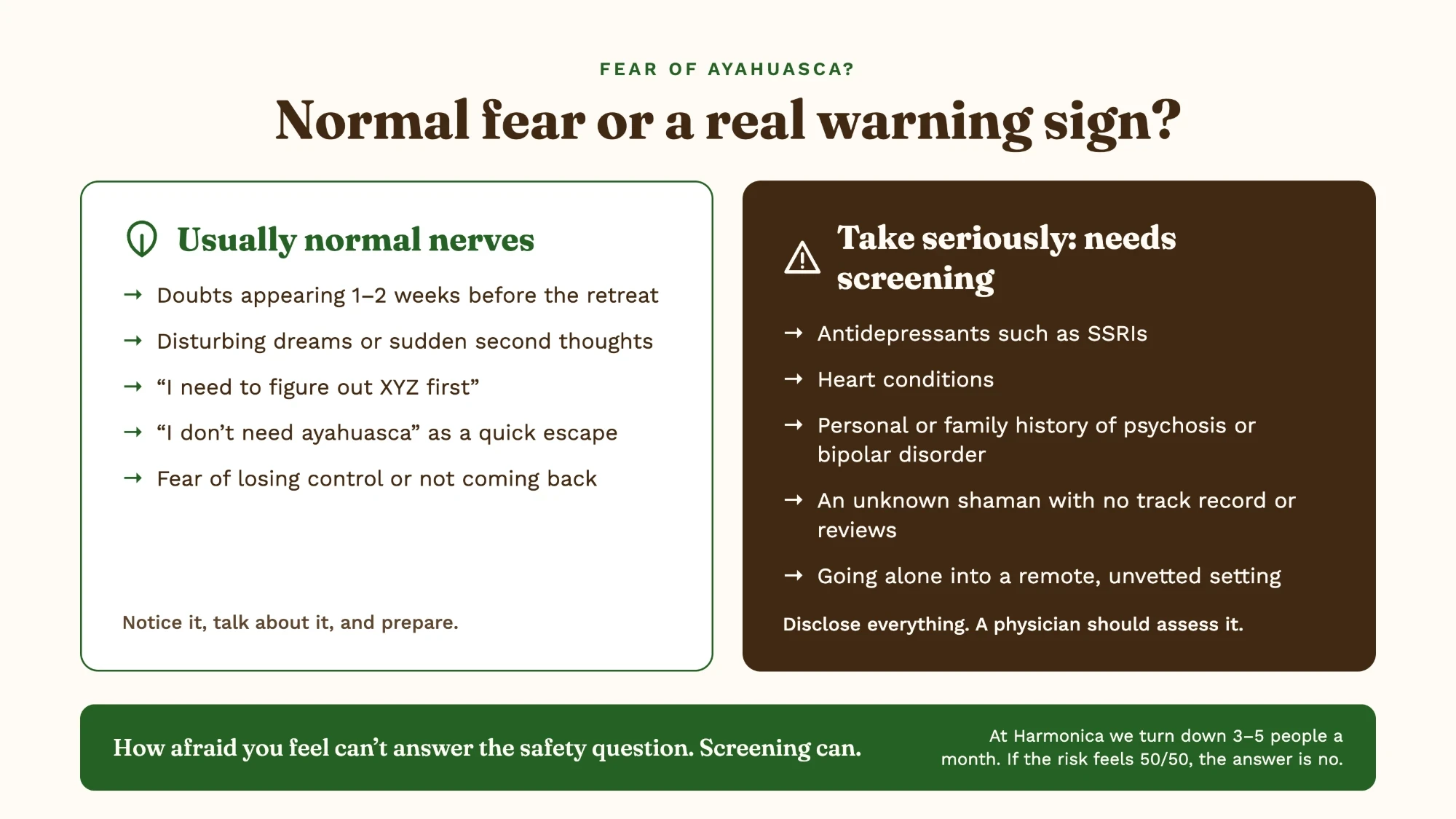
Going alone as a solo female traveler deep into the jungle for a ceremony with a shaman you only heard about could expose you to unnecessary danger. Trust your instincts in that situation, and don't be an idiot.
Choose an established retreat with a track record and positive reviews. Recommendations from trusted friends can also help. Speak with the facilitators and see whether you feel comfortable with their experience and approach.
Medical screening is another part of safety. Antidepressants such as selective serotonin reuptake inhibitors (SSRIs) must be discussed with a doctor and a screened facilitator. Heart conditions and a personal or family history of psychosis or bipolar disorder require individual medical assessment. Some people should not drink ayahuasca at all.
Your amount of fear cannot answer the safety question. One person may feel terrified without having a contraindication. Another may feel calm while leaving out information that changes the assessment.
At Harmonica, we are conservative with screening and turn down around 3 to 5 people each month, because we would rather protect the person’s well-being than hope everything goes well. If the risk feels 50/50, our answer is no. Another retreat may evaluate the situation differently, and the participant can seek another assessment.
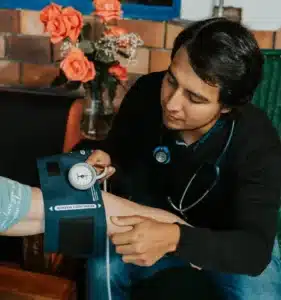
A physician is on our team, but you still need to disclose medications, diagnoses, and relevant family history during screening. Sharing that information is your homework.
Fear of Not Being Ready: "I Want to Figure Out XYZ First"
You do not need to put your entire life in order before drinking ayahuasca. Nobody's life is flawless, and waiting for everything to become perfect can easily become another way of avoiding fear.
Ayahuasca is a loving medicine. Its purpose is not to expose your shortcomings and punish you for them. It can offer guidance while you work with life's imperfections and discover more of your inner strength.
When somebody says, "I need to figure out XYZ first," I think it is useful to examine what sits underneath that thought. Very often, that hesitation is a sign that you are afraid of what you could encounter.
Life remains a work in progress. Approach ayahuasca with an open heart, a willingness to grow, and some trust in your own timing rather than waiting for a perfect moment that may never come.
Fear of Change
Fear of change often comes from worrying that ayahuasca could leave you worse off, make you go crazy, or make you unrecognizable to yourself. Ayahuasca can bring major changes, and people often connect them with greater self-awareness, personal growth, and a closer relationship with themselves.
Change may also feel painful or confusing. Sometimes parts of life break down before you can rebuild them in a healthier way. The ceremony is only part of that process, which is why I wrote about how to integrate your ayahuasca retreat.
I think it is important to ask yourself whether you want your life to change. Growth often means releasing familiar patterns, even when they feel safe.
A crisis can occur after a ceremony, and these difficult moments can also become catalysts for change.
MUST READ: Possible negative effects of Ayahuasca nobody talks about
Fear of Other People's Energy in the Ceremony
Fear of other people's energy can be reduced by choosing a shaman and retreat team you trust. It is normal to worry about absorbing negative energy or feeling triggered by somebody you have never met.
A good shaman and a responsible retreat can hold a supportive environment for the group. And also, somebody who triggers you may offer an opportunity to examine your own reaction. Ask what about that person creates discomfort inside you, especially while you are in the extraordinary state ayahuasca can bring.
Obviously, before choosing a retreat, speak with the facilitators and notice how you feel around them. A well-run center often attracts people with similar intentions. Feeling comfortable with the team and the setting can help you enter the ceremony with more trust, even when you do not know the other participants.
Fear Disguised as "I Don't Need Ayahuasca"
Nobody needs ayahuasca, but saying "I don't need it" can sometimes mask fear. At our core, we have the capacity to find happiness and fulfillment with very few external resources.
Honestly, the question is why that sentence appeared. It may come from genuine self-sufficiency, or it may protect you from confronting fears and vulnerabilities. Ask whether exploring your subconscious, patterns, and inner life could help you understand yourself more clearly.
This is also where intuition and ego can sound similar. Intuition comes from a deeper knowing and a sense of alignment. Ego often focuses on self-protection and resistance to change, creating reasons to delay or avoid an uncomfortable experience.
Pay attention to your internal dialogue. Does your hesitation feel quiet and grounded, or does your mind keep producing new excuses to preserve the status quo?
You may decide ayahuasca is wrong for you. You may also realize that fear has dressed itself as certainty. Careful self-reflection helps you tell the difference and make a decision that belongs to you.
Fear of Losing Control
In most cases, you will be able to control your body during an ayahuasca ceremony. People often ask, "Will I be able to go to the bathroom? Will I scream? Will I remain in control of my thoughts and actions?"
You can usually control your body, and you also have some power over your thoughts, although that part can be more difficult. You can read more in What to expect in your Ayahuasca ceremony.
And also, examine why maintaining control feels so important. Ayahuasca is a mirror for life, and it can reflect parts of us that are difficult to face. Ask where your fear of losing control comes from and how it appears in your daily life.
I think there can be beauty in letting go and surrendering to the experience. That surrender can extend beyond the ceremony and loosen the tight grip you may keep on life. By learning to trust other people, the process, and some uncertainty, you may experience more freedom.
If fear of losing control dominates your thoughts about ayahuasca, it might be an even more compelling reason to go on this journey. You still choose whether to attend, but facing that fear head-on can teach you a lot.
Fear of Going Crazy or Not Coming Back
You do come back, and the effects do end, even when an intense ceremony makes time feel as though it will continue forever. A personal or family history of psychosis is exactly what screening needs to catch beforehand. Inside the moment, however, the fear of going crazy can feel completely convincing.
Before the ceremony, in the sharing circle, we tell participants, "Whatever happens, you are not going to die, and you are going to come back." People often laugh because it sounds obvious. During the ceremony, fear may create the feeling that you are trapped in an infinite loop.
When the intensity continues, I sometimes remind the participant that they are already on the roller coaster. Ayahuasca continues teaching and showing them things, and they can try to remain grateful for the opportunity to see what is coming up.
In a way, we encounter light by getting to know our darkness. Within the Kamsá Biyá tradition, difficult experiences are often understood as fortifying the mind, body, and spirit.
This also has much to do with surrender. Sergio says people often value teachings more when they come through a hard internal battle. Because we worked for those teachings, they can remain with us.
In the video below, I speak more about losing control and the fear of going crazy during ayahuasca.
How Do You Know If You Are Ready for Ayahuasca?
You may be ready for ayahuasca when screening gives no reason to wait and your decision remains grounded after the first wave of fear. I feel like timing is different for each person. Sometimes fear belongs to approaching the unknown, while sometimes waiting is the right choice.
One guest first planned to drink ayahuasca about ten years before coming to us. She signed up for a retreat but could not attend, and she no longer remembers the exact reason. Looking back, she feels she was not ready then.
Another guest was waiting for pickup when the car had a problem. He became angry and wondered whether the delay was a sign that the retreat should not happen. I told him that difficult circumstances happen, and we choose how we interpret those signs.
I sent him a photo of the finca in the sunshine. He came, had an incredible 4-day retreat, and returned for a 7-day retreat a few months later.
Another guest, in his mid to late thirties, finished a one-week retreat and said he wished he had found ayahuasca earlier. We often hear similar reflections from participants who faced their fear and attended.
Readiness needs some grace and also responsibility. In the end, you decide when you are ready. If you are afraid of ayahuasca, you can discuss normal nerves and possible reasons to wait during a free consultation call.
Key Points: Don't Let Fear Control You
- Fear often begins one or two weeks before the retreat, appearing through doubts, disturbing dreams, or logical-sounding reasons to cancel.
- Separate normal fear from real danger by choosing an established retreat, speaking with facilitators, and completing medical and mental-health screening.
- In the Global Ayahuasca Survey, most of those who had difficult mental effects afterwards saw them as part of growth or integration, although some needed professional support.
- If you are afraid of ayahuasca and need help examining your situation, bring your questions to a free 30-minute call.